

HRIC is honored to publish this essential report on behalf of Asian Lawyers Network. Please see the Chinese version of this press release here / 中文版。
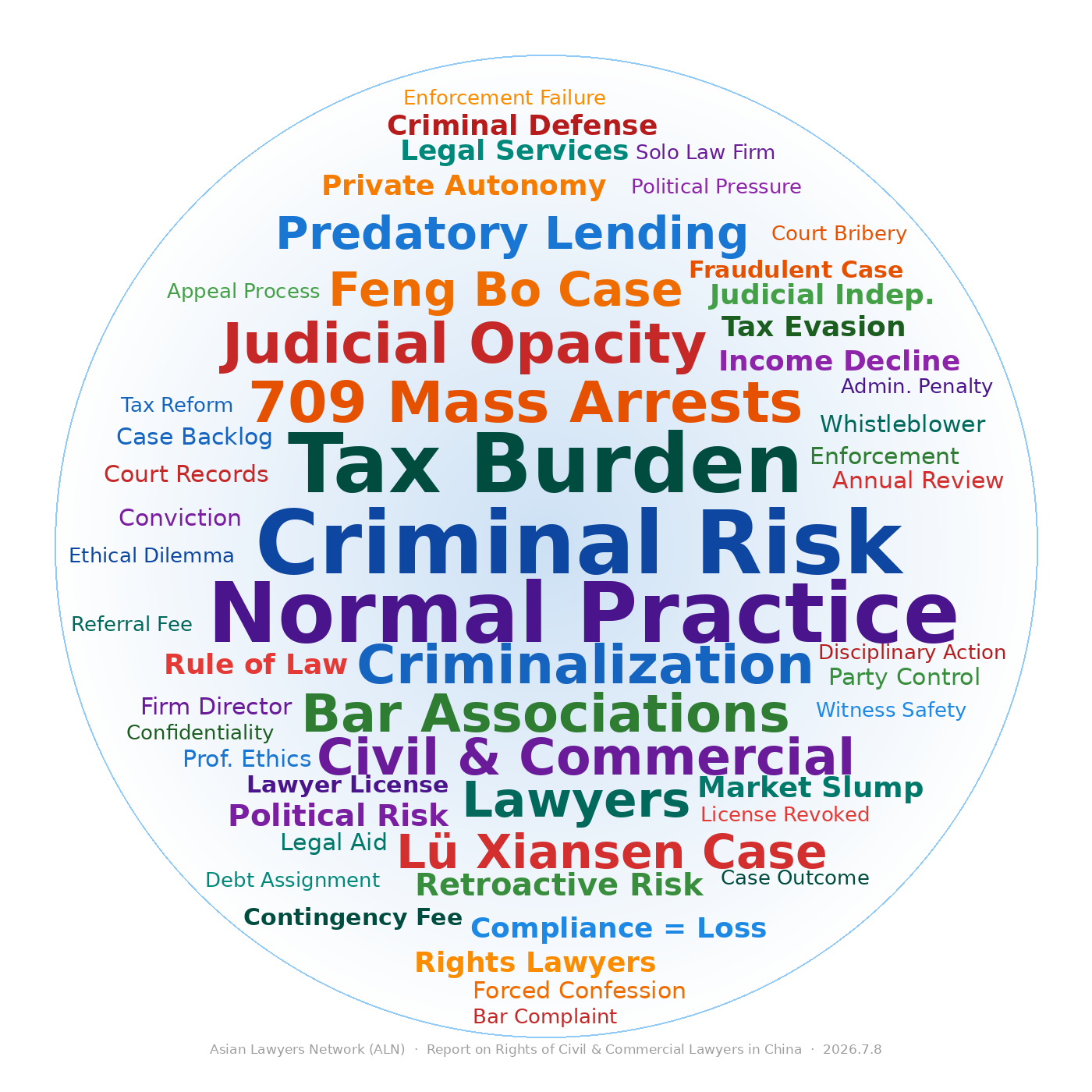
July 8, 2026 — The non-profit organization “Asian Lawyers Network (ALN)” today releases the Report on the Rights and Conditions of Civil and Commercial Lawyers in China. The timing, on the eve of the eleventh anniversary of the “709” mass arrests, is deeply significant. On July 9, 2015, Chinese authorities launched a large-scale crackdown on human rights lawyers and criminal defense lawyers. Eleven years on, this report finds that the effects of suppression have progressively extended to a much broader population: hundreds of thousands of lawyers who have long practiced civil and commercial law—handling contracts, real estate, corporate matters, and debt disputes—now face not only rising criminal risks in their professional work but also the twin pressures of a depressed market and crushing tax burdens. The sense of professional safety that once seemed to characterize civil and commercial practice has been rapidly disappearing.
The report runs to approximately 26,000 Chinese characters. It draws on documentary research, analysis of publicly available cases, in-depth interviews with lawyers, and questionnaire surveys; it includes seven representative cases with complete judicial records; and it cites publicly available data from the Ministry of Justice and local bar associations. It is the first systematic research report to focus specifically on the professional rights and conditions of civil and commercial lawyers in mainland China. Given the administrative regulatory pressures facing the legal profession, this survey does not rely primarily on large-scale surveys conducted under respondents’ real names; instead, it employs targeted sampling, semi-structured interviews, and qualitative analysis methods, with a focus on illuminating the institutional environment and its trends.
Core Finding: Commercial Lawyers Are No Longer Safe
For a long time, a pervasive view within the legal profession held that civil and commercial lawyers occupied a “relatively safe zone” compared with rights defense lawyers and criminal defense lawyers—their work was essentially in the sphere of private autonomy, and did not directly engage national security or ideological red lines. This report finds that this traditional perception is rapidly collapsing.
Ms. Lu Miaoqing, a public interest lawyer from Guangdong, said: “For a long time there was a common understanding in the legal profession: criminal defense and rights cases carried the highest risk, but so long as you focused on civil and commercial work—contracts, corporate matters, real estate—you were relatively safe. Today, that professional consensus has been shattered. Whether a case carries risk no longer depends only on the type of case; it also depends on the case background, the parties’ identities, and the policy environment. What begins as an ordinary commercial dispute can end with the lawyer facing criminal prosecution—or even imprisonment. This high degree of uncertainty is forcing more and more civil and commercial lawyers to recalibrate their professional judgment.”
The report reveals that this spreading risk stems from three overlapping structural shifts. First, the boundaries of political risk continue to expand: cases involving private enterprises, internet platforms, financial disputes, and mass debt are increasingly being invested with political sensitivity, forcing lawyers to conduct preemptive self-censorship before accepting cases. Second, enforcement patterns such as “ the weaponization of criminal law in civil disputes” and “ utilizing criminal prosecution for debt recovery” have proliferated: lawyers’ representational conduct, legal opinions, and even fee arrangements may be retroactively characterized as criminal assistance. Third, the rate at which court judgments are published online plunged to a historic low of 12.5% in 2023, and the combination of judicial opacity and unpredictability has significantly increased the professional risks lawyers bear. These three shifts, acting together, have transformed the professional risk facing civil and commercial lawyers from one driven primarily by market competition to a structural risk shaped simultaneously by political, judicial, and market forces.
The report concludes that when ordinary commercial lawyers face increasing uncertainty even in the course of normal practice, the impact extends beyond the legal profession itself, affecting enterprises’ access to legal services, the security of commercial transactions, and the rule-of-law business environment.
Cases Reconstructed: Normal Practice Becomes Criminal Prosecution
The report’s appendix includes seven representative cases with complete judicial records, each reconstructing the path from normal professional practice to criminal prosecution, providing compelling empirical evidence.
The Feng Bo case is particularly instructive. Feng Bo had served as lawful legal counsel to the head of a chamber of commerce in Guangxi. When the chamber head was subsequently identified as the leader of an organized crime group, Feng Bo was immediately prosecuted for “participation in an organization of the nature of a criminal underworld” and sentenced to ten years’ imprisonment at first instance. The second-instance court found insufficient evidence and overturned the organized crime conviction, but still sentenced him to five years for fraud and assisting in the fabrication of evidence. The core lesson of this case: a lawyer’s normal conduct as legal counsel can be retroactively brought within a criminal evaluation framework, and the uncertainty of professional boundaries has reached an extreme degree.
The Lü Xiansen case illustrates a different dimension of risk. This Anhui lawyer represented clients in multiple ordinary private lending disputes; after the clients were subsequently identified as a “predatory lending” criminal organization, he was charged as a co-conspirator in fraud and sentenced to twelve years at first instance. The second-instance court reduced the sentence to three years, but during the investigation there had been coerced confession under torture, and the relevant video was immediately removed after being made public.
The report concludes that these cases are not isolated incidents but are representative examples of the spreading professional risk facing civil and commercial lawyers in recent years. Though the types of cases differ, all reflect the growing ease with which lawyers’ normal professional conduct can be re-evaluated within a criminal framework.
Dual Squeeze of Market and Institutional Pressures: A Severe Tax Dilemma
The report reveals that, beyond rising political risk, changes in the market environment have further exacerbated the survival pressures facing civil and commercial lawyers. By 2025, the number of practicing lawyers nationwide had reached 830,000, a nearly 1.8-fold increase over ten years, yet the pace of growth in demand for legal services has fallen far short of supply. Average per-lawyer revenue among Beijing lawyers fell from RMB 843,300 in 2019 to RMB 687,200 in 2023. Based on surveys from bar associations across China, 2023 saw the first-ever net outflow of young lawyers from the profession. At the same time, even as income declines, the tax and fee system has not been correspondingly adjusted, leaving many lawyers under the dual pressure of shrinking revenue and a relatively heavier tax burden.
On the tax and fee front, the report reveals a structural dilemma: if lawyers strictly comply with tax requirements, their combined tax burden can reach 40%–50% of income; if they adopt the tax arrangements common in the industry, they may at any moment face joint action by tax and public security authorities. The report characterizes this situation as “universal criminalization”—full compliance means operating at a loss, while tax avoidance means breaking the law. Whether a lawyer opts for strict compliance or the tax arrangements that are prevalent throughout the industry, they may be exposed to significant operational or legal risk.
Li Fangping, a prominent rights lawyer in Beijing, noted: “What civil and commercial lawyers in China face today is not a single problem but a convergence of multiple pressures: political risk, judicial uncertainty, market competition, and a tax and fee system that bears down on them from all sides. A depressed market has continuously eroded lawyers’ incomes, while tax and compliance costs have not decreased in step—many lawyers are already in a situation that is difficult to sustain over the long term. If this trend continues, the impact will extend beyond the legal profession itself and will undermine the capacity of market players to obtain legal services in accordance with the law.”
Recommendations: Reform Bar Associations and Reduce Tax Burdens
The report puts forward three core recommendations:
First, promote the return of bar associations to genuine professional autonomy. Under the current system, bar associations are effectively controlled by judicial and administrative authorities, with the position of the Chinese Communist Party branch secretary concurrently held by a government official, leaving them unable to represent lawyers’ interests. The report recommends that, measured against the UN’s 1990 Basic Principles on the Role of Lawyers, bar associations be transformed from “stability-maintenance tools” into genuine representative institutions for lawyers’ rights. These recommendations also accord with the requirements of the UN Basic Principles on the Role of Lawyers and other international standards regarding independent practice and professional self-governance.
Second, reform a tax and fee system that is deeply unfair to lawyers. The report recommends expanding the range of costs deductible before tax, allowing cross-year income smoothing mechanisms, and recognizing in tax law the quasi-legal-person status of law firms in order to release the vitality of the profession and reduce the institutional incentives that force lawyers to walk the line of compliance.
Third, establish a clear professional withdrawal mechanism. When a lawyer discovers during representation that a client has engaged in illegal conduct, the current system provides neither a protected withdrawal path nor a clear exemption from the obligation to report illegal conduct. Drawing on the experience of mature jurisdictions such as the Law Society of Ontario in Canada, the report recommends establishing a clear and workable mandatory withdrawal procedure to provide lawyers with institutional protection.
The report concludes that the problems facing civil and commercial lawyers in mainland China are not merely a professional crisis within the legal community. When ordinary commercial lawyers must continuously weigh criminal risk, market pressure, and tax burdens even in the course of normal practice, the effects will spill over into business operations, commercial transactions, and the public’s ability to obtain legal services in accordance with the law. The decline in lawyers’ sense of professional safety will ultimately affect the overall rule-of-law environment and market confidence.
Report Access
Full report (Chinese): https://hricmedia.s3.us-west-1.amazonaws.com/_af9bebee10.pdf
AI-generated English translation: https://hricmedia.s3.us-west-1.amazonaws.com/Report_on_Civil_Commercial_Lawyers_Rights_China_23e98389d4.pdf
Or click to download here:
