

During Xi Jinping’s visit to Washington, DC, Chinese pro-democracy activists and other protesters critical of Beijing were repeatedly subjected to encirclement, seizure of their banners, pepper-spraying, and physical assault. Large, organized welcoming groups were also present around the hotel where Xi was staying. The violence that occurred three years earlier during the Asia-Pacific Economic Cooperation (APEC) summit in San Francisco, along with the previously investigated and documented organizational ties between Chinese diplomatic missions and pro-Beijing diaspora groups, is once again an unavoidable backdrop against which to assess the events in Washington.
HRIC is in close contact with witnesses and victims of the attacks. Media is welcome to reach out for further information.
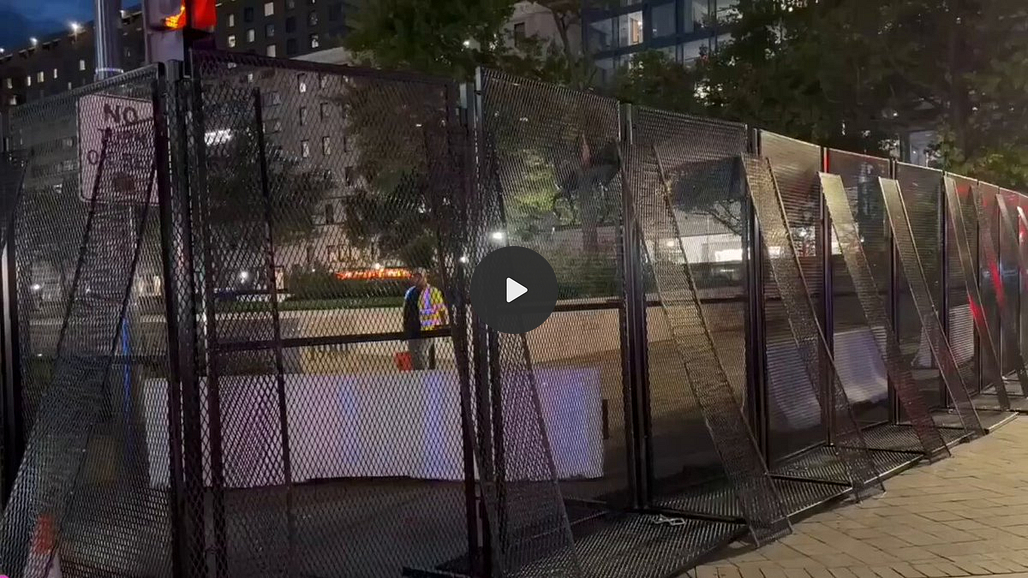
On September 23, before Xi arrived in Washington, the Waldorf Astoria hotel where he would be staying went into full security lockdown. A tall, anti-climbing fence was constructed around the hotel with police stationed by the barrier, a security perimeter spanning approximately three blocks was established between 9th and 12th Streets, with a checkpoint set up on 10th Street, and in the days leading up to the visit, emergency no-parking zones and road closures were progressively implemented on sections of 10th Street, 12th Street, Constitution Avenue, and Pennsylvania Avenue surrounding the hotel.
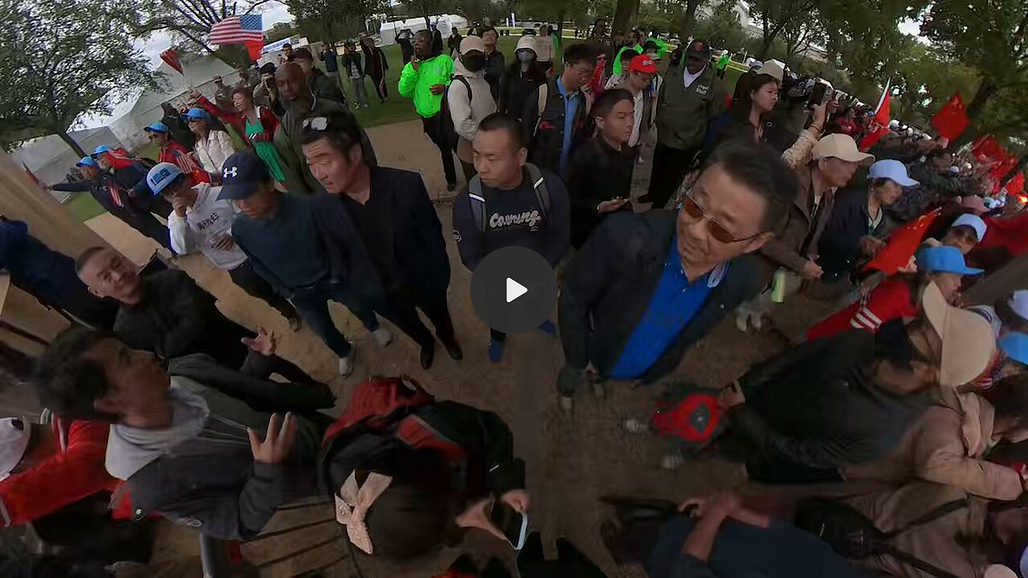
After Xi Jinping’s arrival, the area outside the security barriers was quickly occupied by two starkly contrasting groups: on one side were Chinese democracy activists, Tibetans, Uyghurs, Hong Kongers, and other protesters brandishing slogans such as “Xi Jinping Step Down” and “China wants freedom, democracy, human rights, and the rule of law,” while on the other side, a dense sea of red flags bearing five yellow stars marked the large crowds of pro-Beijing supporters waiting at the hotel, the airport, and along the motorcade route. At one point, around 200 members of Xi’s welcoming party gathered outside the hotel, waving Chinese and American flags and chanting slogans of welcome.
Reports from the welcoming camp itself stated that approximately 100 overseas Chinese associations participated, including the American Fujian Association, the Fujian Sanshan Association, the Fujian United Association, the Lianjiang Association, and various chambers of commerce, with some groups chartering buses from New York, Philadelphia, and other locations to travel to Washington, DC. Chen Shanzhuang, quoted in reports by the welcoming side, noted that he had arrived in Washington two or three days in advance. In other words, this was not a chance street encounter between a few supporters and protesters; rather, Xi Jinping’s visit brought together two large groups with diametrically opposed political stances within a highly secured yet extremely confined public space. The roar of more than three thousand protesters pierced through the massive, organized efforts of pro-CCP forces to block them out. Reporters confirmed that even from locations such as the entrance to the White House banquet hall, protest chants of “Xi Jinping, you are not welcome! Xi Jinping, xia tai (step down)!” could be clearly heard.
Just prior to Xi Jinping’s arrival in the United States, HRIC joined 29 other human rights, press freedom, and civil society organizations in signing an open letter that not only called for the release of political prisoners and an end to transnational repression, but also put forward a specific demand: that Xi publicly guarantee, before arriving in the United States, that members of his delegation and “affiliated individuals” would not engage in transnational repression or collective retaliation against protests and boycotts during the visit.
This demand was not based on hypothetical concerns. In recent years, the U.S. Department of Justice has indicted multiple officials from China’s Ministry of Public Security, accusing them of using thousands of fake online identities to monitor, harass, and threaten Chinese pro-democracy activists in the United States. Meanwhile, a report on transnational repression released this June by the Congressional-Executive Commission on China (CECC) identified physical assaults, threats against family members in China, digital harassment, forced repatriation, censorship, and “lawfare” as tools employed by the Chinese government and associated actors against overseas critics.
For this reason, the events that unfolded on the streets of Washington, D.C., from September 23 to 25 cannot be reduced merely to a clash between “supporters and protestors” on the sidelines of a diplomatic visit. Instead, given the established track record of transnational repression, critical questions must be asked: Who was organizing the crowds? Who was monitoring the protesters? And why did individuals peacefully expressing dissent once again become targets of physical assault?
From Harassment and Pepper Spray to Physical Assault
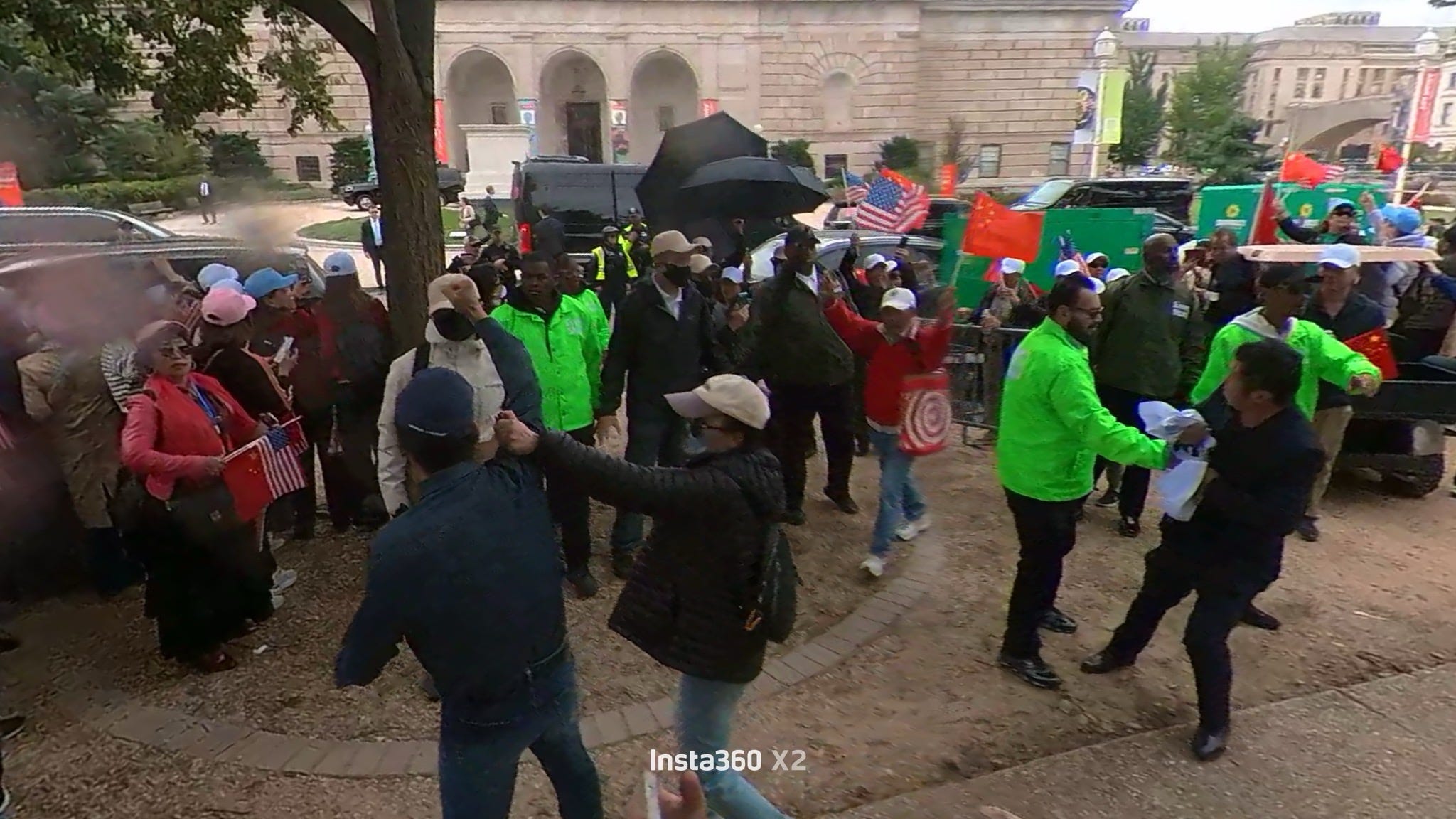
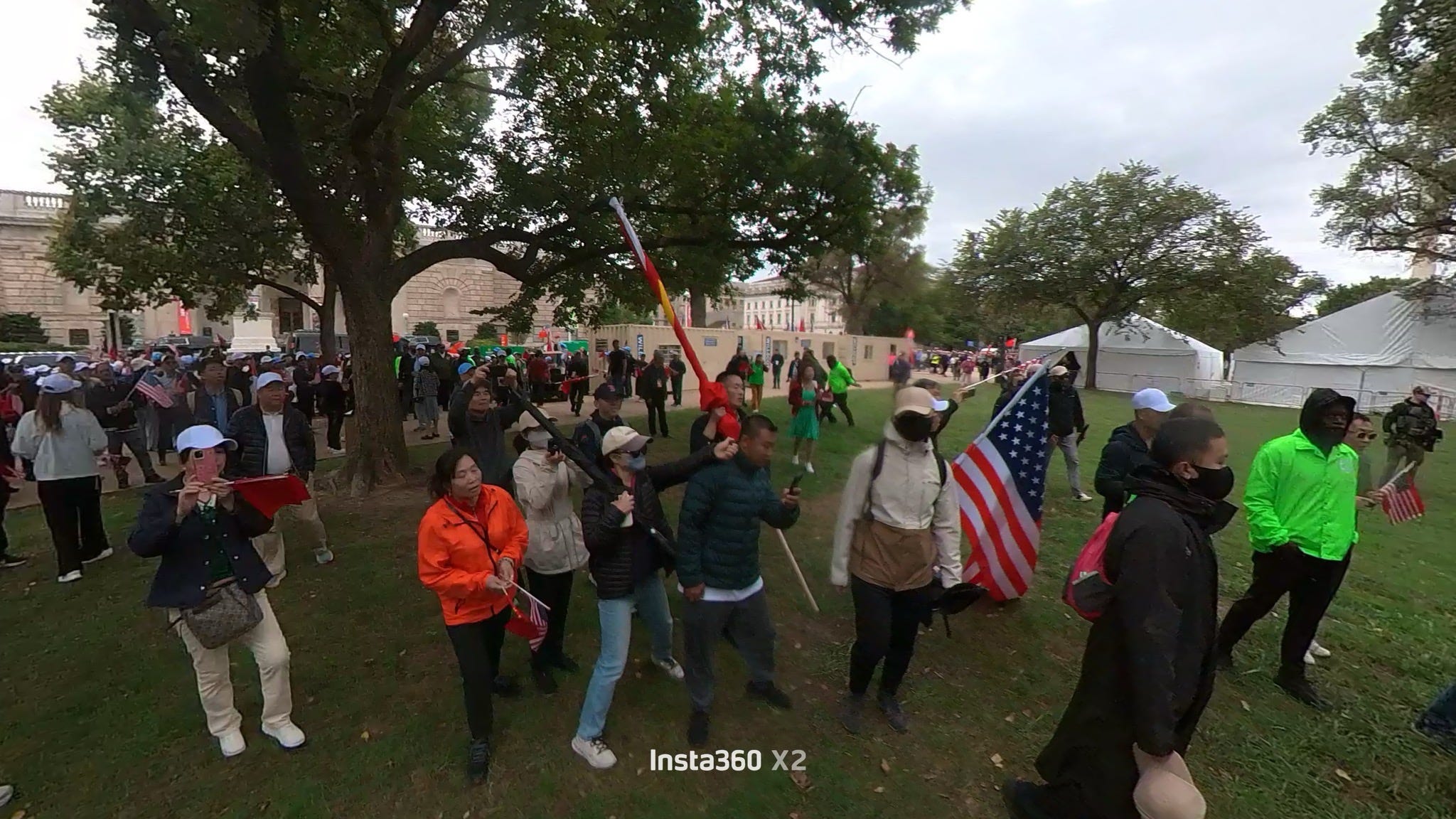
Conflicts began the day Xi Jinping arrived. Outside Joint Base Andrews, where welcoming crowds and anti-Xi protesters were initially kept apart, scuffles broke out over the seizure of banners and physical altercations ensued. Video footage from the scene shows individuals entering the ranks of protesters to film and snatch items, as well as someone using a stainless-steel flagpole wrapped in a Chinese national flag to jab at protesters. On September 24, the conflict escalated further: protesters Geng Guanjun, Hu Pizheng, Huang Mingfa, and Guo Jianxin were sprayed with pepper spray by pro-Beijing individuals while demonstrating against Xi, and protestor Niu Pengfei was surrounded, choked, beaten, and dragged by several individuals dressed in black.
That same day, a smaller group of Chinese pro-democracy protesters was also surrounded and attacked while First Lady Peng Liyuan was out in public. In the early hours of September 25, another physical altercation occurred outside the Chinese Embassy. Publicly available video shows protesters being attacked near the embassy entrance, prompting police intervention. Washington police confirmed five protest-related arrests on September 24, including charges involving the assault of a police officer, the unlawful seizure of another person’s property, and simple assault. The repeated incidents of banner-snatching, pepper spray, harassment, and beatings over several days caused the protests to quickly escalate from a confrontation of beliefs into a matter of personal safety.


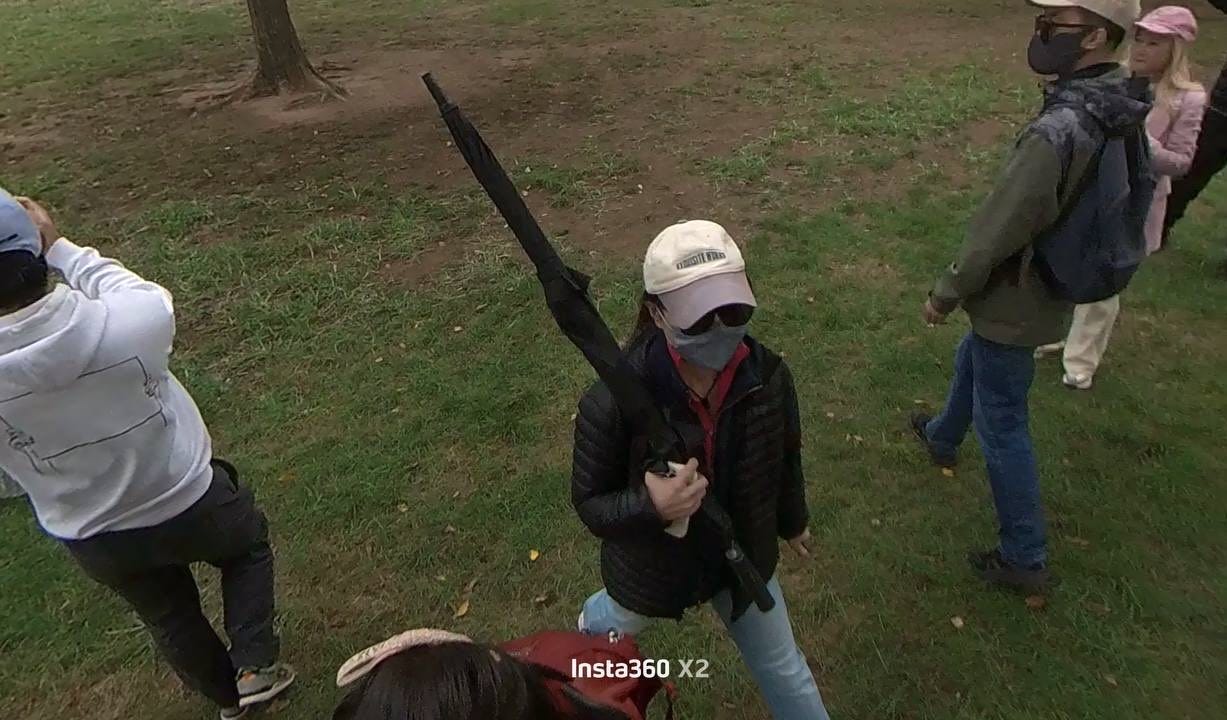
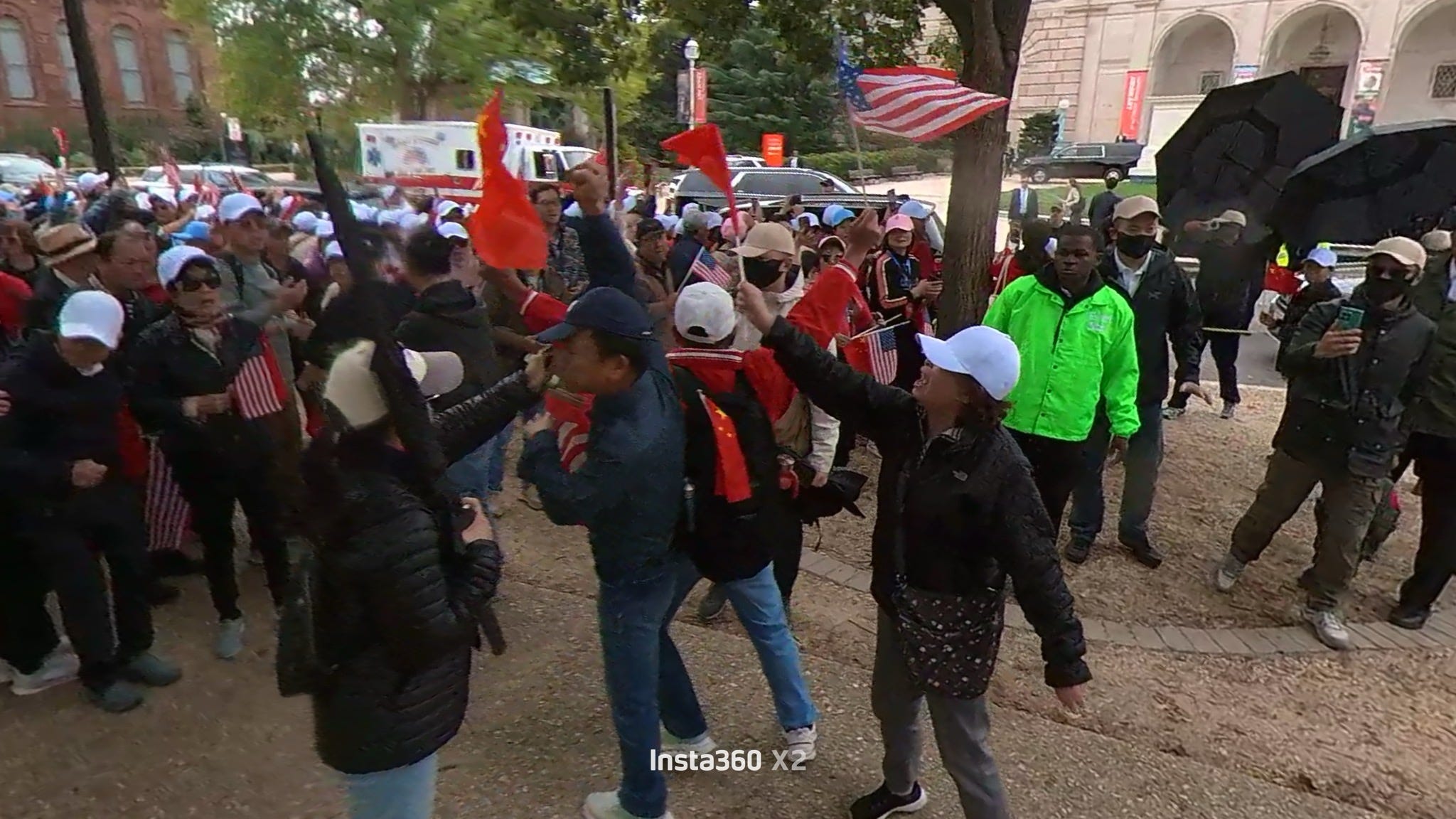
Even more noteworthy is the repeated appearance—across footage from various locations—of a group of individuals dressed in black who exhibited highly similar patterns of behavior: young-to-middle-aged men wearing matching dark clothing, baseball caps, face masks, earpieces, or sunglasses, some carrying black umbrellas, moved between the welcoming crowds and the protesters, filmed the demonstrators, and rapidly converged whenever a confrontation broke out. Based on their uniform attire, conduct, and equipment, activists on the ground identified some of these individuals as security personnel accompanying the Chinese delegation. On-site video footage clearly shows one woman among this group specifically targeting pro-democracy activists with pepper spray.
The question of these individuals’ identities has moved beyond mere street-level speculation. Hong Kong Democracy Council (HKDC) reported that Washington police explicitly told representatives from Students for a Free Tibet (SFT) that at least one of the assailants was not detained “because he has diplomatic immunity,” while Samuel Bickett stated that police told SFT the individual was part of the diplomatic team accompanying Xi Jinping. Hong Kong activist Joey Siu pointed out that several of the activists who were attacked are U.S. citizens. As of this writing, the U.S. State Department has not publicly disclosed the individual’s name or specific status; however, if police were indeed unable to arrest a suspect accused of assaulting protesters due to diplomatic immunity, the issue is clear: the U.S. government must clarify whether this person was part of Xi Jinping’s diplomatic or security entourage and explain why diplomatic immunity would serve as an obstacle to addressing street violence.


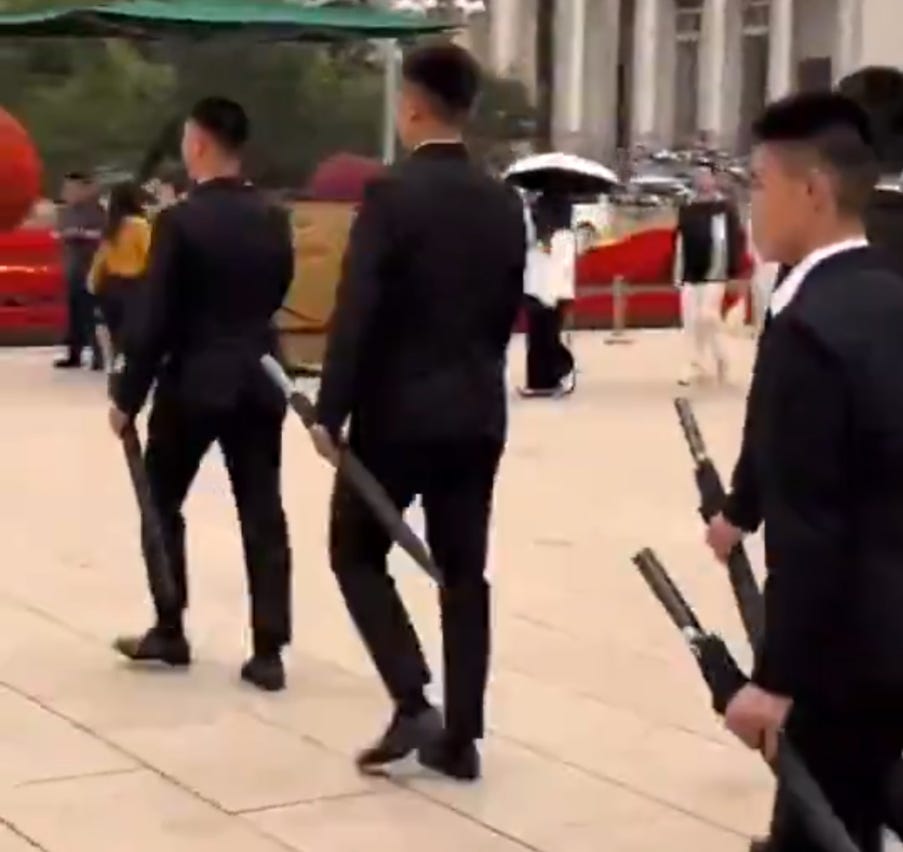


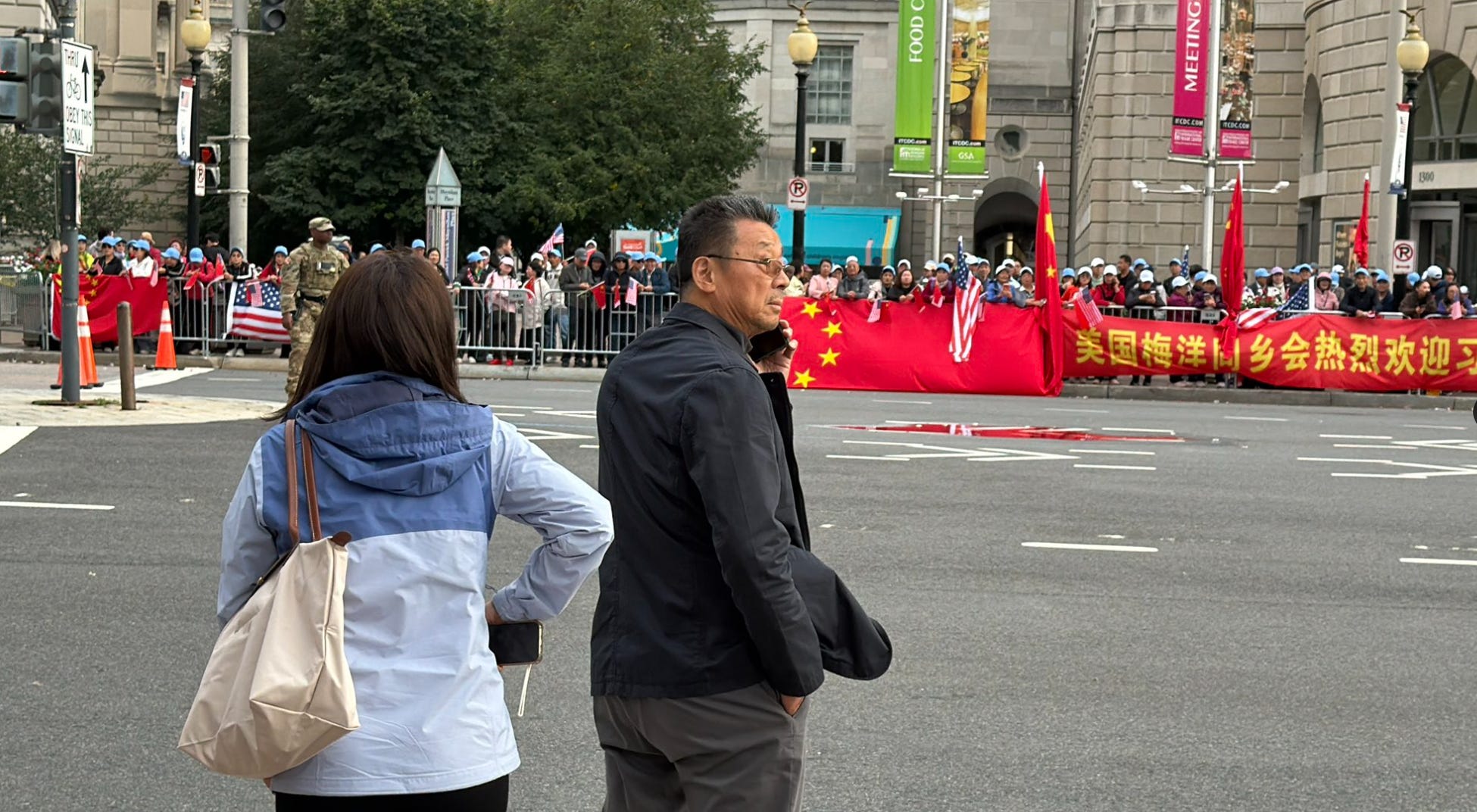
The organized nature of the welcoming contingent was unmistakable. Reports from the welcoming side itself explicitly stated that around 100 Chinese expatriate associations participated in the event, listing various hometown associations and chambers of commerce; another report noted that groups from New York, Brooklyn, Flushing, Philadelphia, and elsewhere transported participants to Washington in chartered buses. In on-site interview footage, some elderly participants openly told interviewers that their attendance was organized by “New York hometown associations.” Numerous videos and screenshots circulated on social media showing the mass transport of participants by bus, the centralized distribution of boxed meals, and even recruitment notices. One widely shared recruitment message detailed arrangements such as transportation, accommodation, and an $80 stipend, though different sources cited varying figures for the actual payment.
Regardless of the final payment situation, this centralized organization by expatriate associations, the interstate bus charters, the bulk distribution of flags, and the provision of communal meals all indicate a mobilization effort that was carefully planned and well-resourced. In contrast, dissident organizations and individuals mostly traveled to Washington D.C. independently. This asymmetry in manpower, resources, and operational capacity directly shaped the dynamics on the street.
Familiar faces from San Francisco reappear in Washington
This situation warrants concern partly because it demonstrates a clear continuity with events that occurred during Xi Jinping’s visit to the APEC summit in San Francisco in 2023. A systematic review of over two thousand photos, videos, police records, medical reports, WeChat group messages, and testimonies from more than thirty witnesses revealed that, while clashes occurred from both sides during Xi’s four-day visit to San Francisco, the most severe acts of violence were perpetrated by pro-CCP activists and individuals who coordinated their actions from within the welcoming crowd: anti-Xi protesters were struck with flagpoles and metal objects, sprayed with chemicals, and subjected to punches and kicks, with some even beaten to the point of temporary unconsciousness. The investigation also confirmed that the Chinese Consulate General in Los Angeles covered hotel and meal expenses for some of the individuals present to welcome Xi; at least 35 pro-Beijing overseas Chinese associations attended; and at least four diplomats from the Chinese consulates in San Francisco or Los Angeles appeared in the welcoming crowds and interacted with individuals who were later involved in violent clashes. Chinese diplomatic missions have denied these findings, claiming that the crowds welcoming Xi Jinping were also subjected to provocation and violence. A report titled Exporting Repression, jointly produced by HKDC and SFT, documented 34 specific incidents of harassment, intimidation, and assault, and tracked various overseas Chinese associations and figures closely linked to United Front networks.
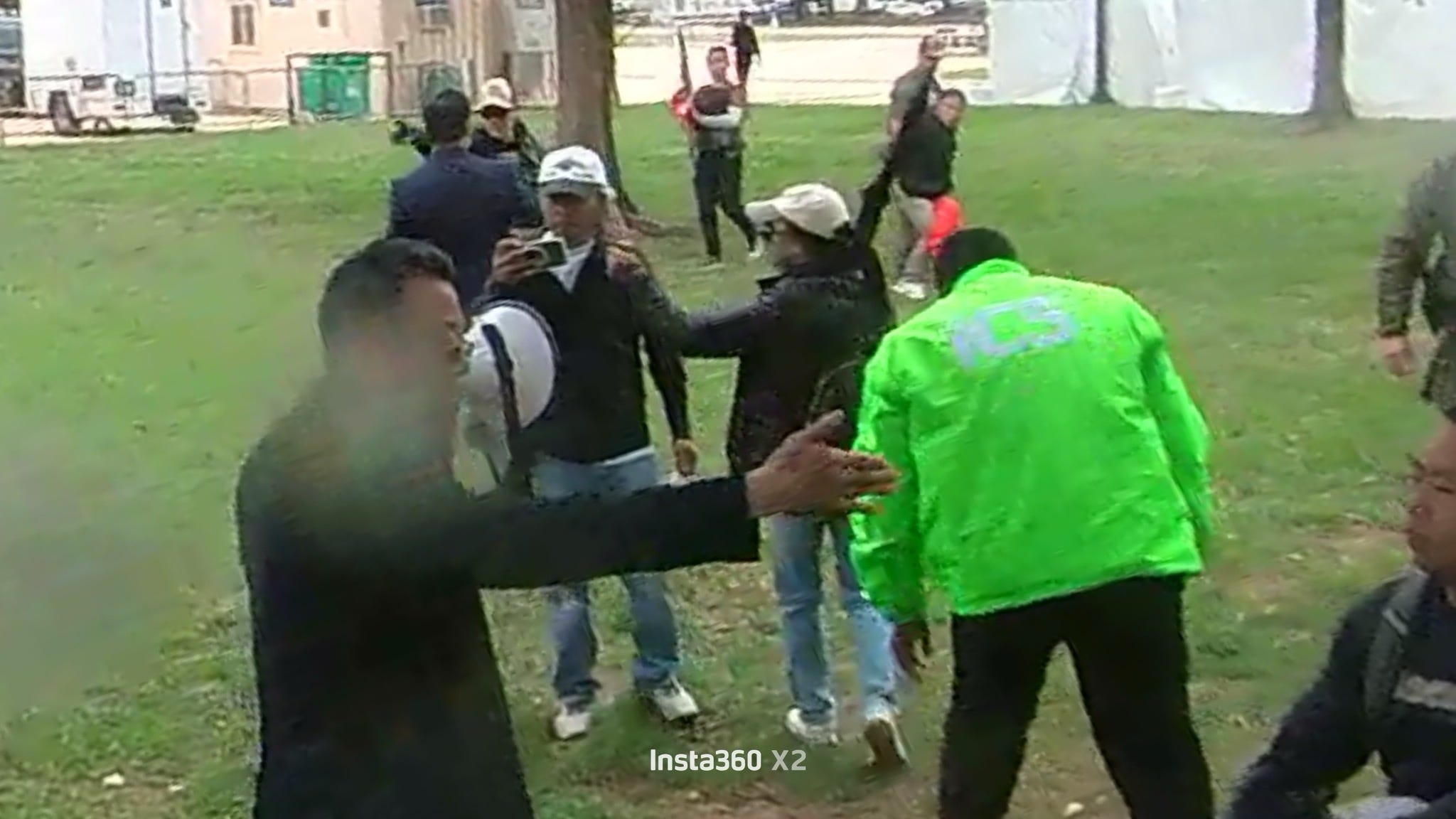
Some key organizers from 2023 reappeared at the Washington D.C. event, most notably John Chen Shanzhuang (陈善庄), a pro-Beijing community leader from New York. Investigations into the San Francisco incident revealed that Chen had organized a group from New York to travel to San Francisco to welcome Xi Jinping. Three years later, Chen arrived in Washington days in advance of the visit and appeared publicly at the welcoming event, which involved approximately 100 overseas Chinese associations. Video footage obtained by Human Rights in China clearly shows that, at the scene when pro-democracy activists were attacked, Chen was the only person holding a megaphone and visibly acting as an on-site coordinator. Individuals wearing hats, face masks, and sunglasses, dressed in dark clothing, could be seen operating around him. At these locations, pro-democracy activists were surrounded, struck with umbrellas, beaten, and sprayed with pepper spray. Chen’s repeated presence at pro-Beijing mobilization efforts and scenes of violence during Xi Jinping’s two visits to the United States constitutes significant evidence that should warrant investigation by U.S. law enforcement.
During a confrontation on September 24 near 17th Street NW and New York Avenue, police arrested five individuals protesting against Xi Jinping; one of them, Pi Qiaohai, was subsequently transferred to ICE custody.
Attacks against pro-democracy activists during the APEC summit in San Francisco in November 2023 were documented by organizations such as Human Rights in China (HRIC) and investigated in detail by the media. According to HRIC’s current information, no pro-CCP individuals faced criminal charges for violence directed at anti-Xi protesters at that time; similarly, as of the publication of this article, there are no public records of pro-Beijing attackers facing criminal charges for the events in Washington D.C. In stark contrast, all five individuals arrested on September 24 near 17th Street NW and New York Avenue, confirmed by HRIC through legal counsel to be anti-Xi pro-democracy activists, faced legal action, with Pi Qiaohai subsequently placed in ICE detention. In both instances, anti-Xi activists were arrested and criminally prosecuted, yet there appear to be no corresponding records of prosecution for the pro-Beijing individuals suspected of carrying out attacks, despite the existence of extensive video footage. U.S. law enforcement agencies have a responsibility to explain this stark disparity.
The most critical question regarding Xi Jinping’s visit to the U.S. is not whether welcoming crowds have the right to support him—they certainly do, it is not as if protesters opposing Xi Jinping possess some special political right, they were merely exercising the freedoms of expression and assembly to which everyone in the United States is entitled. The real issue is whether an individual who has left China due to opposition to the Chinese government remains subject to surveillance, harassment, intimidation, or even physical assault in the United States because of that same political stance, and whether U.S. law enforcement and diplomatic systems can identify and prevent such conduct in a timely manner when the perpetrators may be linked to Chinese diplomatic missions or official delegations.
Even before Xi Jinping arrived in the United States, HRIC called upon his delegation and their U.S.-based associates to refrain from engaging in transnational repression against protesters. After the visit concluded, this issue did not vanish; instead, it became even more concrete due to the various videos captured on the streets. For Chinese dissidents who have long endured the pressures of being targeted from all sides, harassed, and subjected to transnational repression, the events in Washington raise a very simple question: once they have left China, can they truly voice opposition to the Chinese government on the streets of a democratic nation without fearing physical assault?
Additional Details and Observations
Altercations involving items being snatched from protestors and attacks with flagpoles occurred outside Joint Base Andrews on September 23. On September 24, as First Lady Peng Liyuan was leaving the National Museum of Asian Art, Geng Guanjun reported being jabbed with the tip of an umbrella, knocked to the ground, and sprayed in the eyes with pepper spray; Niu Pengfei reported being surrounded and attacked by three individuals dressed in black; Huang Mingfa reported being pepper-sprayed three times and kicked; and Guo Jianxin reported a woman spraying pepper spray at four pro-democracy activists. That same afternoon, near the Environmental Protection Agency (EPA), Falun Gong practitioner Xin Qin reported being pulled down, beaten, and bitten by Li Huahong and others.
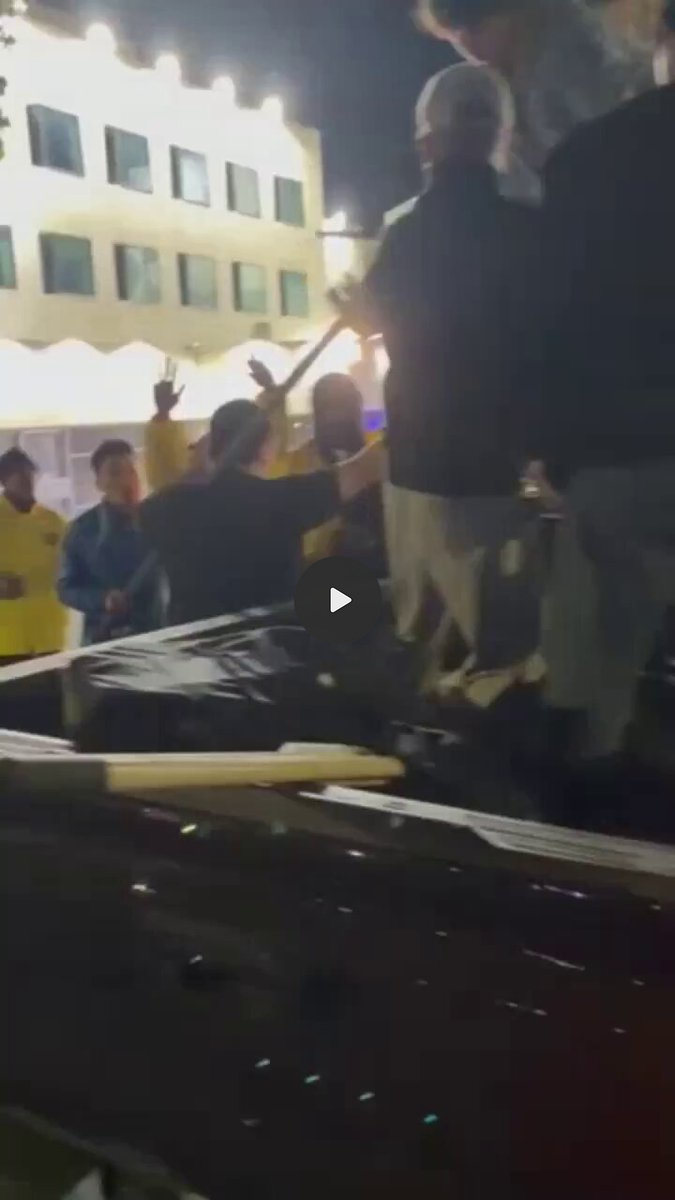
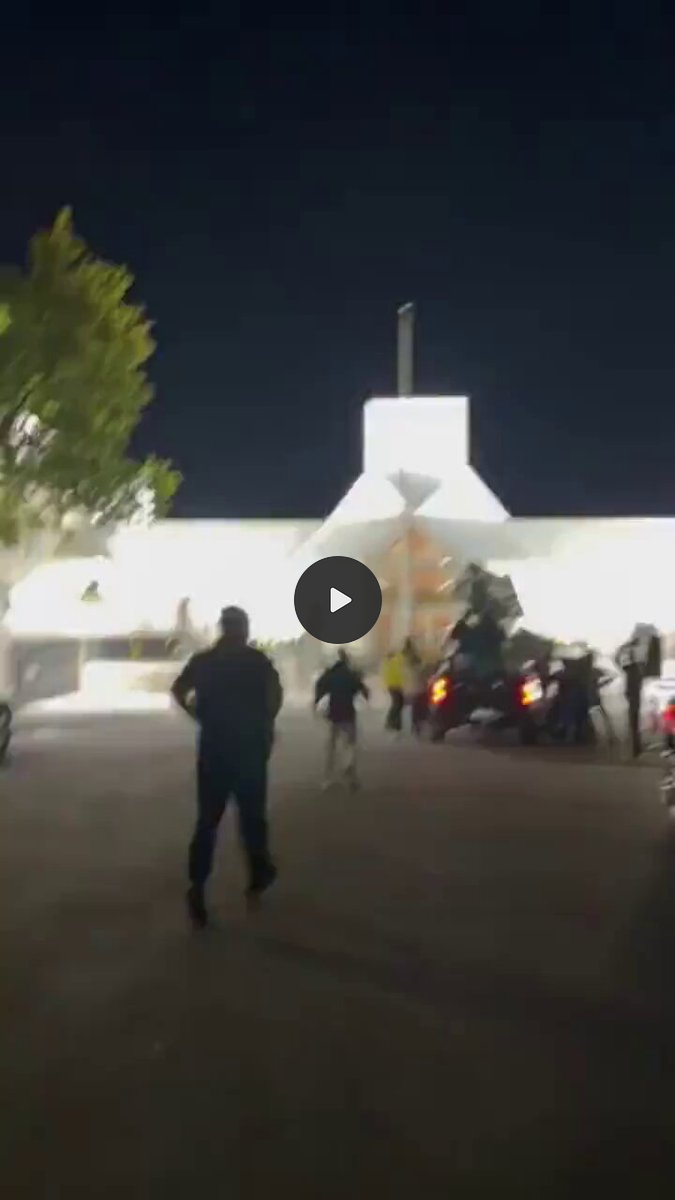
Late on the night of September 24 and into the early hours of September 25, several individuals reported that people emerging from the direction of the Chinese Embassy attacked protesters who were displaying projected images. Yuan Zegang stated that he was stabbed in the abdomen with a rod-like object and that his vehicle sustained damage to its windows and body; other reports indicated that one person was left bleeding on the ground and required hospitalization. Publicly available video footage shows that after police arrived, some of those involved in the altercation retreated toward the embassy. Law enforcement must ascertain the identities of these individuals—whether they were embassy staff, security personnel hired by the embassy, members of Xi Jinping’s delegation, or others.
On September 25, incidents involving banner-snatching, encirclement, and physical blows occurred again outside the National Archives.
HRIC seeks further investigation into the following questions:
Have official cases been opened for every incident of assault involving video evidence, injuries, and witnesses that occurred over the three-day period?
Have the individuals who attacked protesters using pepper spray, umbrellas, flagpoles, and other objects been identified?
Who are the individuals dressed in black, who repeatedly concealed their identities with hats, masks, and sunglasses, and rapidly gathered during the clashes? Is there any shared organization, employment, or chain of command linking them?
What is the identity of the individuals who emerged from the Chinese embassy side to participate in the clashes?
How was Li Huahong handled after being handcuffed by the police? Was a formal case opened? Were criminal charges filed?
Why is there no record of criminal prosecution to date for the individuals suspected of carrying out assaults, despite the existence of extensive publicly available video footage?
While the 2023 San Francisco incident is not the main concern of this article, it offers a reference point that cannot be ignored: similar large-scale mobilizations by pro-Beijing diaspora groups—featuring some of the same organizers, individuals clad in black to conceal their identities, umbrellas, flagpoles, and pepper spray, alongside the surrounding, stalking, filming, and physical assault of anti-Xi Jinping protesters—reappeared almost identically in Washington D.C., three years later.
Human Rights in China does not question anyone’s right in the United States to welcome Xi Jinping, wave the Chinese flag, or express support for the Chinese government; opposition to Xi Jinping is likewise protected by the U.S. Constitution. However, whoever commits violence must be investigated and held legally accountable. To date, information available to HRIC indicates that no pro-CCP individuals were criminally prosecuted for violence against anti-Xi protesters in San Francisco in 2023; similarly, there are no public records of pro-Beijing attackers facing criminal prosecution for the events in Washington in 2026. Meanwhile, anti-Xi pro-democracy activists were among those arrested and criminally prosecuted in connection with both incidents.
Diplomatic courtesies must not serve as a shield for the CCP to suppress dissent, diplomatic immunity cannot justify impunity for street violence, and political stances must not determine who receives legal protection and who faces prosecution.
Appendix: Video screenshots and links to related evidence
In on-site video footage provided by protester Cai Xiaoli, a large group of individuals dressed in black are seen attacking pro-democracy activists. One woman sprays pepper spray at four people, while Chen Shanzhuang directs the scene while holding a megaphone. Link to original YouTube video: 习近平访美期间:华盛顿有组织袭击民运人士,辣椒水攻击,陈善庄现场指挥
Sequential screenshots:
Li Laoshi on Twitter/X (李老师不是你老师):





China Action on Twitter/X:


Cai Xiaoli (蔡晓丽) on Twitter/X:


Yuan Zegang (袁泽刚) on Twitter/X:


Sound of Hope on Twitter/X:


Jie Lijian (界立建) on Twitter/X:

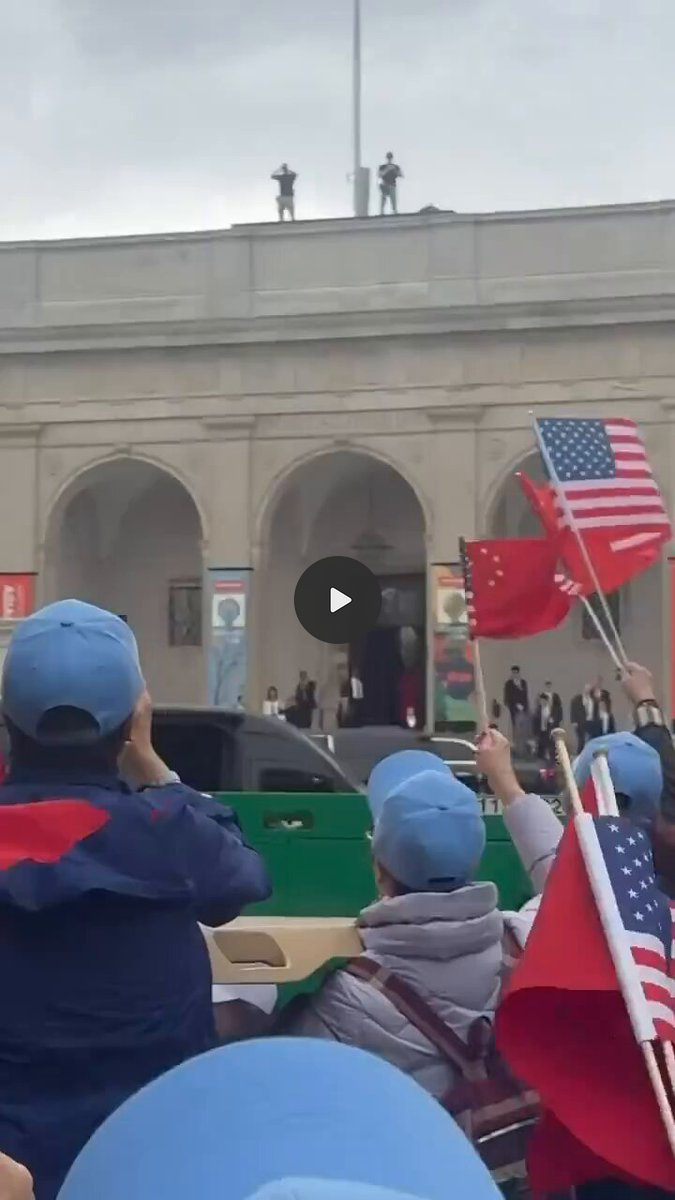
Chen Xiangwei (陈翔威) on Twitter/X:

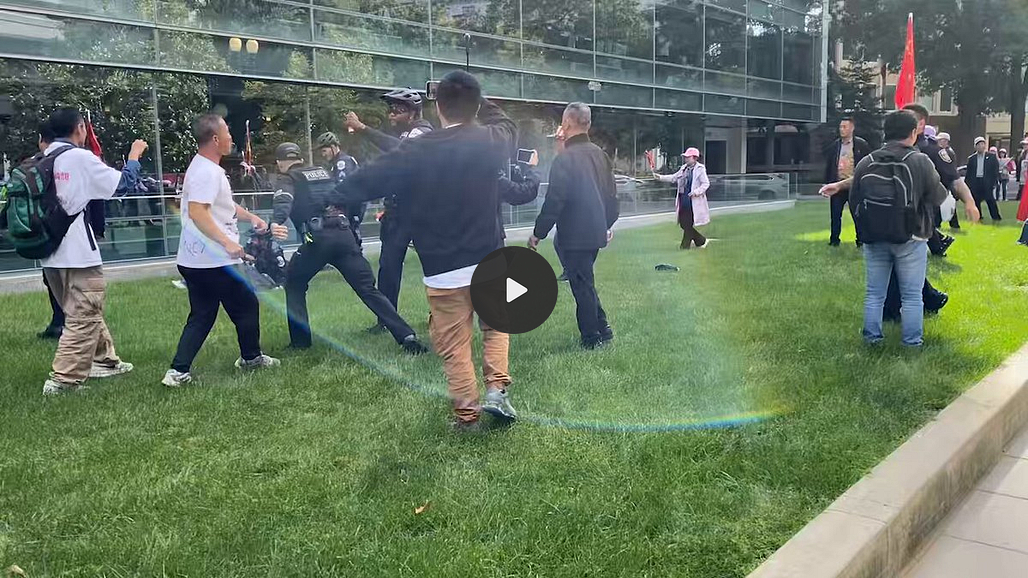
ZhengWei on Twitter/X:


Byron Wan on Twitter/X:


“Team Leader Li is not your team leader” (李班长不是你班长) on Twitter/X:

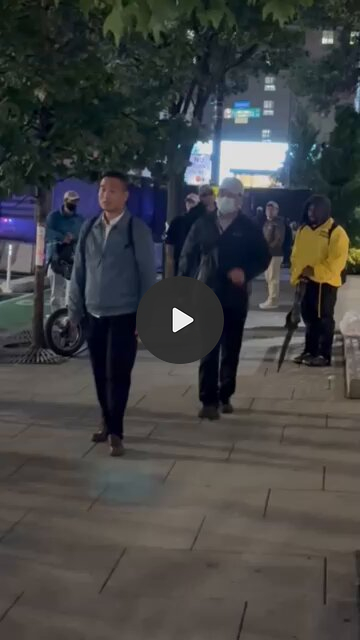
Huang Yaoyi (黃耀毅) on Twitter/X:


ALLIN on Twitter/X:

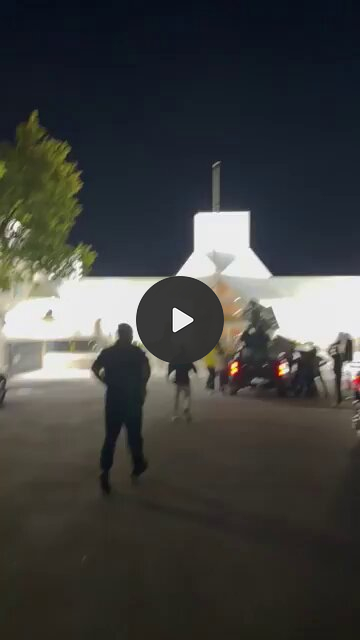
News Coverage
FTV/Yahoo! News: “Protesters Attacked by ‘CCP Personnel’! Netizens Slam: Bringing Transnational Repression to the Forefront”: https://tw.news.yahoo.com/抗議者遭-中共人員-攻擊-網轟-把跨境鎮壓擺上檯-083528320.html
Liberty Times: “Protesters Gather Outside the White House! Footage Reveals ‘Xi Jinping’ Being Slapped”: https://news.ltn.com.tw/news/world/breakingnews/5585903
Liberty Times: “Protesters Swarm Outside Hotel Where Xi Jinping Is Staying; ‘Unidentified Individuals’ Spotted Monitoring the Scene”: https://news.ltn.com.tw/news/world/breakingnews/5585961
NTD News, “On the night of the Trump-Xi summit, CCP agents attacked protesters outside the Chinese embassy”: https://www.ntdtv.com/b5/2026/09/25/a104136250.html
NTD News, “Faces of Xi supporters revealed; at least 39 protest groups turned out to ‘welcome’ Xi”: https://www.ntdtv.com/gb/2026/09/25/a104136124.html
NTD News, “News Weekly: Trump-Xi Summit Concludes; 39 Groups Stage Persistent Protests of the Event”: https://www.ntdtv.com/gb/2026/09/26/a104136676.html
NTD San Francisco: “Pro-CCP Individual Attacks Falun Gong Practitioner in Washington; Police Make Arrest and Open Case”: https://ntdsf.tv/2026/09/24/親共者華盛頓襲擊法輪功學員-警方逮捕立案/
The Epoch Times: “Protesters in Washington D.C. Assaulted by CCP Thugs During Xi’s U.S. Visit” (Chen Deyi): https://www.epochtimes.com/gb/26/9/26/n14857674.htm
The Epoch Times, “Pro-Beijing Woman Arrested After Allegedly Attacking Protester Amid Trump–Xi Summit”: https://www.theepochtimes.com/china/pro-beijing-woman-arrested-after-allegedly-attacking-protester-amid-trump-xi-summit-6094648
The Epoch Times, “In Photos: What We Saw in DC Outside Trump–Xi Summit”: https://www.theepochtimes.com/article/in-photos-what-we-saw-in-dc-outside-trump-xi-summit-6095147
Vision Times: “Protesters Attacked During Xi’s US Visit: Mystery Surrounding Chinese Man in Face Mask and Black Umbrella Revealed”: https://kzg.io/news/gb/2026/09/28/1105365.html
Vision Times: “Clashes Erupt Between Welcoming Crowds and Protesters!”: https://kzg.io/news/gb/2026/09/24/1105229.html
Chinascope, “Beijing-Organized Xi Supporters Clashed with Protesters Outside Andrews Airport”: https://chinascope.org/archives/41343
Voice of Freedom and Democracy — “A Record from the Scene of the Protest Against Xi Jinping’s US Visit in Washington (Part B) — Twitter Video”: https://myxth.org/archives/10961
WJLA 7News, “Several arrested as crowds gather near White House for Chinese President’s visit”: https://wjla.com/news/local/dc-white-house-support-protest-chinese-president-xi-jinping-china-arrest-police-new-york-avenue-17th-street-crime-trump-washington
inkl, “What Really Happened Outside the White House During Xi’s Visit…”: https://www.inkl.com/news/what-really-happened-outside-the-white-house-during-xis-visit-involving-five-arrests-and-two-standoffs
Tibetan Review (Citing MPD arrest figures from WUSA9): https://www.tibetanreview.net/arrests-reported-as-tibetans-other-protesters-dogged-president-xi-on-second-day-of-his-us-state-visit/
The Diplomat, “’Xi, You’re Not Welcome’…”: https://thediplomat.com/2026/09/xi-youre-not-welcome-as-trump-hosts-chinas-leader-thousands-protest-in-washington/
ClickOrlando, “Protesters of Xi’s policies push for change in earshot of White House visit with Trump”: https://www.clickorlando.com/news/politics/2026/09/25/protesters-of-xis-policies-push-for-change-in-earshot-of-white-house-visit-with-trump/
Voice of America: “Xi Jinping Faces Protests from Multiple Groups and Ethnic Communities During U.S. Visit”: https://www.voachinese.com/a/xi-jinping-s-visit-to-the-u-s-met-with-protests-organized-by-various-groups-20260924/8204227.html
Voice of America, “Protesters and Supporters Gather Outside the National Archives”: https://www.voachinese.com/a/national-archives-protesters-and-supporters-20260925/8204303.html
Radio Free Asia, “Xi Jinping’s Visit to the U.S.: Support and Protests Coexist on the Streets of Washington”: https://www.rfa.org/mandarin/xinwenkuaixun/2026/09/24/xi-us-visit-washington-supporters-protesters/
RFI: “Protest groups ‘welcome’ Xi Jinping in Washington; hundreds shout ‘not welcome’ outside the Chinese Embassy”: https://www.rfi.fr/cn/中国/20260924-抗议团体华盛顿-迎-习近平-中使馆外数百人高喊-不受欢迎
BBC Chinese, “Demonstrators Gather in Washington, D.C. to Protest Xi Jinping’s Visit to the U.S.”: https://www.bbc.com/zhongwen/articles/cwly7j71n1k4o/sim
ADV Podcaster (at 46 minutes): https://www.youtube.com/live/Ew5igWMd248?is=aY-2dWp_sNMag0dP