

Wuhan activist Zhang Yi has been charged with “inciting separatism” after showing a photograph of the Dalai Lama in Lhasa. For his son, Zhang Hongyuan, who lives in the Netherlands, this was not an unforeseen tragedy, but a day he had spent three years preparing for—and dreading.
“Usually, it’s fathers who go to the police station to collect their sons. For me, it was a son going to the police station to collect his father.”
(Read the Chinese version here / 中文版)
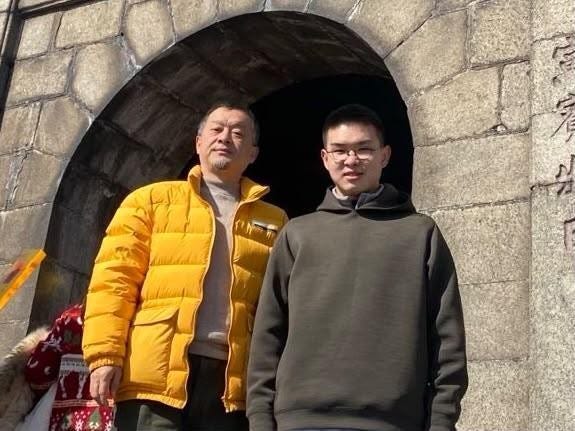
On the afternoon of 1 July 2026, at Sera Monastery in Lhasa, Tibet, Zhang Yi, a retired man from Wuhan, saw a Tibetan woman praying and wanted to borrow a mat from her. They didn’t share a common language; she couldn’t speak Mandarin. Zhang Yi pulled out his mobile phone, found an old photograph, and showed it to her.
There were two people in the picture. One was the Dalai Lama, and the other was a friend Zhang Yi had known for years—a Han Chinese Buddhist monk who had previously been imprisoned in China for his beliefs. Only this spring, the two friends had travelled together across southern China for a fortnight.
Zhang Yi simply wanted to tell the woman in front of him: The man in this photo is my friend, and he has met the Dalai Lama.
Instead, the woman frantically waved her hands and quickly looked away. She didn’t dare to look.
Her reaction caught the attention of two men in black nearby. They walked over and demanded to see the photo as well. Zhang Yi ignored them and turned to leave. The two men in black exchanged a few more words in Tibetan with the woman.
Shortly after, while Zhang Yi and his brother were browsing souvenir stalls inside the monastery, they noticed the two men filming them on their mobile phones. Before the brothers could even step out of the monastery gates, the police had arrived. At around 5:30 PM, the pair were taken to the Lhasa Public Security Bureau.
His brother was later released; Zhang Yi was kept in custody.
A mat meant for prayer, an old photograph on a mobile phone, and a failed attempt at conversation—these ultimately became the entire basis for a case of “inciting separatism.”
“Usually, it’s fathers who go to the police station to collect their sons”
Following his father’s arrest, Zhang Hongyuan, living in the Netherlands, did not consider returning to China immediately.
This might differ from what people imagine a son’s instinctive reaction to be. But Zhang Hongyuan knew full well that going back wouldn’t save his father; it would likely just deprive his family of its only voice on the outside. In the Netherlands, he can contact local governments, international organizations, and friends across Europe. If he returned to China, he would almost certainly be forced into silence, just like his father.
“There is much more I can do on the outside,” he told Human Rights in China.
However, choosing not to return didn’t mean he didn’t want to bring his father home.
In truth, Zhang Hongyuan has been trying to do just that since he was a young teenager.
Once, he came home from school to find his father missing. After asking around, he discovered Zhang Yi had been taken to the police station again. Zhang Hongyuan was only fourteen or fifteen at the time. He walked into the police station alone and told the officers that he needed to eat and there were no adults left at home.
The staff at the station gave him a pot noodle. He sat there and waited.
“If you don’t let him go, I’m not leaving,” he said.
In later years, Zhang Hongyuan would often recount this memory with a bitter smile: “Usually, it’s fathers who go to the police station to collect their sons. For me, it was a son going to the police station to collect his father.”
That wasn’t the only time in his childhood he had to face the state apparatus invading his home.
One evening during the early days of Xi Jinping’s rule, a group of state security agents (guobao) and police escorted Zhang Yi home for a raid. Zhang Hongyuan remembers being about thirteen or fourteen. Seeing so many police officers standing in his house for the first time, he was understandably terrified. His father simply told him: “Don’t worry.”
Zhang Hongyuan went back to his room, shut the door, and began to play the piano.
Outside the door, the police were rummaging through their belongings and confiscating the computer; inside, a teenage boy played the piano non-stop. He couldn’t prevent the search, nor did he know if his father would be taken away again. The only thing he could do was use the music to drown out the noise outside, and to mask his own fear.
After the police left, he was the only one left in the flat.
Looking back years later, Zhang Hongyuan still remembers how his father came in to comfort him before being taken away. Zhang Yi always seemed to be comforting others, even when he was the one in real danger.
The place where his father ‘worked’
When he was little, Zhang Hongyuan didn’t know why the police kept taking his father away.
Even earlier on, Zhang Yi had taken him to an abandoned detention facility near Hanzheng Street. The building was being used by local merchants as a warehouse; it was dim and dilapidated. His father walked him around inside and said, “I used to stay here.”
Young Zhang Hongyuan misheard, thinking his father had said, “I used to work here.” In a child’s imagination, being a policeman was an impressive career. For a long time, he even believed his father used to be a police officer.
It wasn’t until secondary school that he realized it wasn’t a place his father had worked, but a place where he had been locked up.
Following Xi Jinping’s rise to power at the end of 2012, the crackdown on civil society and dissidents escalated rapidly. The following year, Zhang Yi began facing heavier surveillance for continuing to engage with civil society figures and attending a friend’s wedding. State security personnel came to his door every month to take his photograph. The history his father had carefully kept hidden could no longer be kept from his son.
That was when Zhang Hongyuan finally learned that his father’s life was permanently tethered to another year: 1989.
Zhang Yi graduated from university in 1988 with a degree in law. By 1989, he was working as an electrician for the Wuhan water board. He was not a “student leader” as some reports have claimed, but after the June Fourth crackdown, he joined the local protests in Wuhan and was arrested for blocking the Beijing-Guangzhou railway for roughly two hours. The family still keeps the old newspapers that reported the incident.
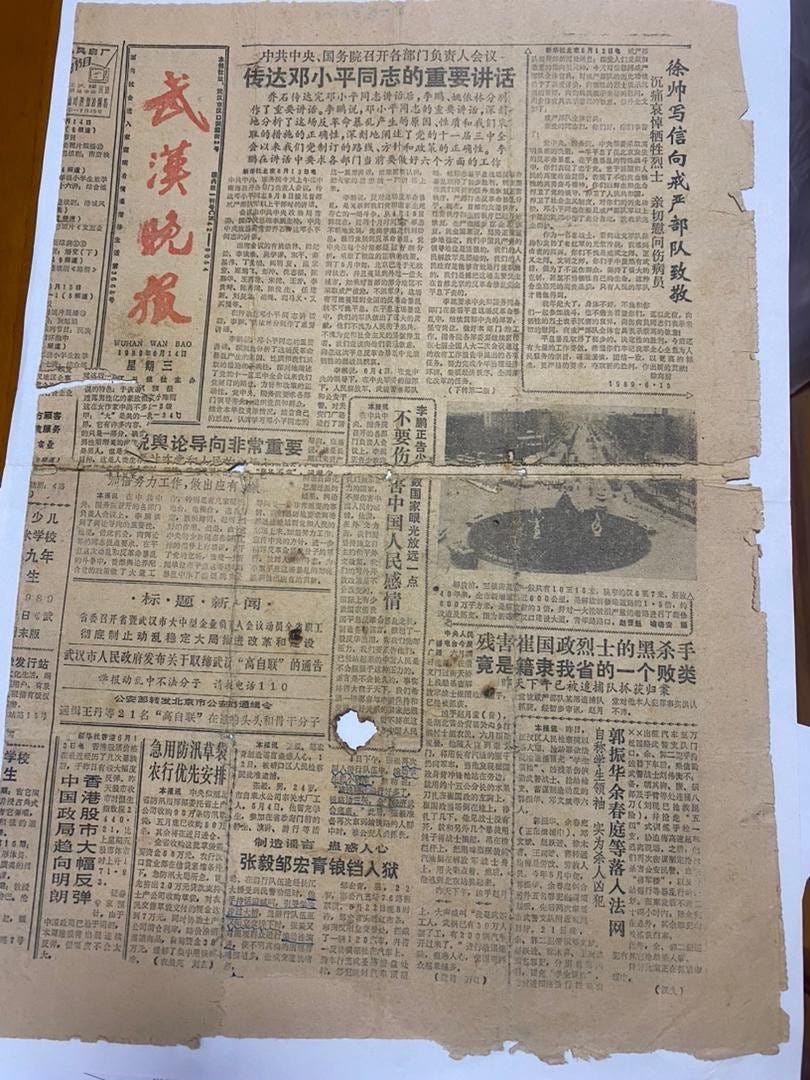
More than three decades later, Zhang Yi still talks about that year. He once told those close to him: “I should have died in ‘89. I didn’t die; I’m just dying late.”
To Zhang Hongyuan, this wasn’t an expression of suicidal thoughts, but rather his father’s way of explaining the rest of his life. For Zhang Yi, 1989 never truly ended. Every time he voiced support for someone, visited a political prisoner, or was summoned and detained, it felt like a long, drawn-out echo of that year.
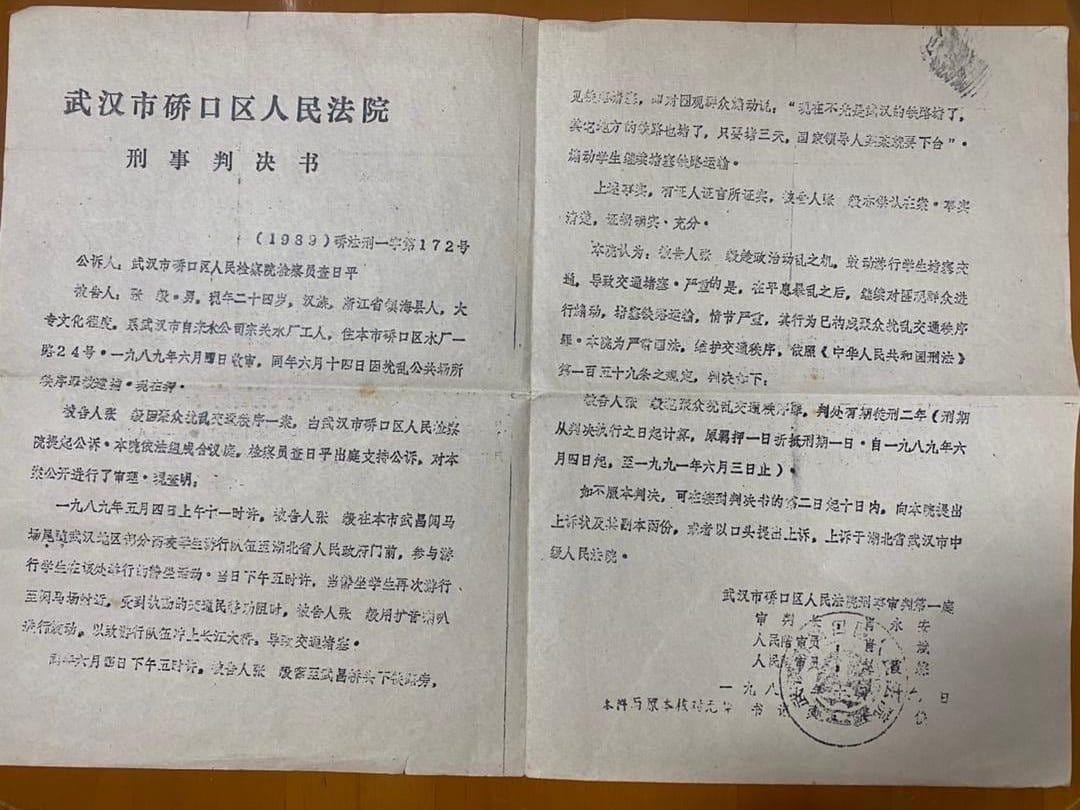
When he first learned the truth as a young teenager, Zhang Hongyuan told his father: “Dad, I think you’re brilliant.”
But “brilliance” woven into the daily fabric of family life isn’t always an easy burden to bear.
A great father, but also one his son once resented
Zhang Hongyuan does not paint his father as a flawless hero who never caused his family pain.
He remembers the family’s hardest times. His father was under constant surveillance, which restricted his job prospects. The family drove a cheap Alto, and during Chinese New Year, they sometimes had to borrow ten or twenty thousand yuan from friends just to get by.
Back then, he felt aggrieved.
He saw other fathers focusing on their careers, making money, and providing for their families, while his father was always at civil society gatherings: supporting someone today, visiting someone else tomorrow, attending a friend’s funeral the day after. Then would come the state security visits, the summons, the police stations, and a family constantly waiting for the next crisis.
It’s hard for a child not to ask: Why can’t my dad just focus entirely on our family, like everyone else?
Zhang Hongyuan admits he used to resent him. Not because he thought his father was doing the wrong thing, but because political persecution never just targets one person. It seeps through the front door, onto the dinner table, into a child’s school fees and holidays, and eventually alters how a family views one another.
Later, through a friend who had also been imprisoned, Zhang Yi started working as a distributor in Wuhan for Dawu Liquor, owned by the entrepreneur Sun Dawu. The family’s income finally stabilized, and Zhang Hongyuan’s school fees and living expenses were no longer such a stretch.
Zhang Yi wasn’t actually a good drinker. His son recalls that in the early years, a small glass was enough to make him drunk. He slowly trained himself to handle alcohol just to do the job. This man, who rarely bowed to reality throughout his life, was learning in his own way how to be a father who needed to put food on the table.
Yet, he never stopped participating in public affairs.
Zhang Yi would take his son to gatherings within the Wuhan citizen circles, introducing him to his friends. Sitting at the dinner table, Zhang Hongyuan listened to these people share their experiences of being detained, suppressed, and stripped of their rights. Hearing and seeing so much, he slowly came to realize that his father wasn’t constantly stepping out the door because he didn’t care about their home.
It was precisely because he couldn’t only care about his own home.
“Many people only realize that someone has always been resisting on their behalf when the iron fist finally smashes into their own interests,” Zhang Hongyuan said.
The resentment his father once made him feel eventually transformed into a more complex understanding: Zhang Yi might not have been a father who could shelter his family from the storm, but he was a man who couldn’t pretend not to notice when others were drowning in it.
The state security agent who came to the house to ‘make friends’
The person responsible for Zhang Yi’s long-term surveillance was a local state security (guobao) chief in Wuhan. Zhang Hongyuan said that at the time, his father was one of the primary “stability maintenance targets” in their district. The agent once explicitly stated he wanted to “make friends” with the father and son, even coming to their home to eat and drink, staying until 11 PM.
Zhang Hongyuan, still in secondary school, finally couldn’t take it anymore. He told the man very seriously: “You need to leave. You are not welcome in our home. We need to sleep, and your wife and children are waiting for you at home too. You need to leave right now.”
The agent eventually went downstairs. Before leaving, he remarked to Zhang Yi how surprised he was that Zhang Hongyuan, who was younger than his own son, dared to speak to him like that.
From that day on, Zhang Hongyuan never saw him again.
But out of sight didn’t mean the surveillance was gone.
During politically sensitive periods, Zhang Yi would be forcibly taken out of Wuhan—a practice state security referred to as a “forced holiday” (被旅游). Zhang Hongyuan experienced this alongside his father twice. The two of them would travel, flanked by four state security agents. Food, accommodation, and transport were all paid for out of special funds. Zhang Hongyuan saw with his own eyes how meals that cost a few hundred yuan were invoiced for one or two thousand, and a thousand-yuan hotel stay was receipted as three thousand.
To him, his father wasn’t just treated as a person needing control; he had been turned into a profitable “stability maintenance project.” The state security agent was the “project manager,” and Zhang Yi was the asset.
Later, as local government budgets tightened, these “holidays” became much more basic. Agents stopped taking Zhang Yi out of town. Instead, they would find a farmhouse on the outskirts of Wuhan and lock him in for a few days. He might be able to fish and eat, and it didn’t look like a prison, but he couldn’t leave, nor could he decide where to spend his time.
In China, controlling a person doesn’t always require a prison cell. Sometimes it’s a car trailing behind them, a dinner table shared with monitors, a farmhouse room they cannot freely leave, or a man who turns up on schedule every month to take a photograph.
“I knew he would definitely be arrested, it was just a matter of time”
Zhang Hongyuan eventually left China and moved to the Netherlands.
The very day he left, a media outlet reported on his situation. The local police station immediately deployed officers to put Zhang Yi under 24-hour rotational surveillance. From April right through until the end of the June Fourth anniversary, three people took turns guarding him.
The father remained in China; the son gained his freedom. For Zhang Hongyuan, these two realities could never truly be separated.
During a festival in Amsterdam, seeing people who had moved from China to Europe dancing freely in the crowd, he unexpectedly broke down in tears. He later understood this feeling as survivor’s guilt: Why do I get to live in a free country, while countless people I know are still living in fear?
“I can’t just enjoy a free life in the Netherlands and forget everything back home,” he said.
Foreign friends advised him not to worry so much, telling him not to carry the weight of the world on his shoulders. His response was: “Because I love this world. All these people and events have something to do with me.”
Freedom didn’t sever his ties to the past; it only made his attachments sharper. He knew that his departure could put his father at even greater risk.
“From the day I got out, I knew Zhang Yi would definitely be arrested. It was just a matter of time,” he noted.
Because of this, he spent three years preparing for the day his father would actually be taken. He built networks, identified governments, institutions, and human rights workers to turn to, and constantly mapped out who he should contact first, what he should say, and how to get the word out as quickly as possible when that day finally came.
A son spent three years preparing for his father’s inevitable arrest.
This preparation couldn’t numb the pain when it actually happened. It only ensured that when the agony arrived, he wouldn’t be entirely paralyzed.
“From the outside I have been constantly speaking out and rallying support, and I will never back down!” Zhang Hongyuan stated.
Who exactly did one photograph ‘incite’?
On 18 July, Zhang Yi was moved from administrative detention to criminal detention, held at the Lhasa Detention Centre on suspicion of “inciting separatism .” About twelve days later, his formal arrest was approved.
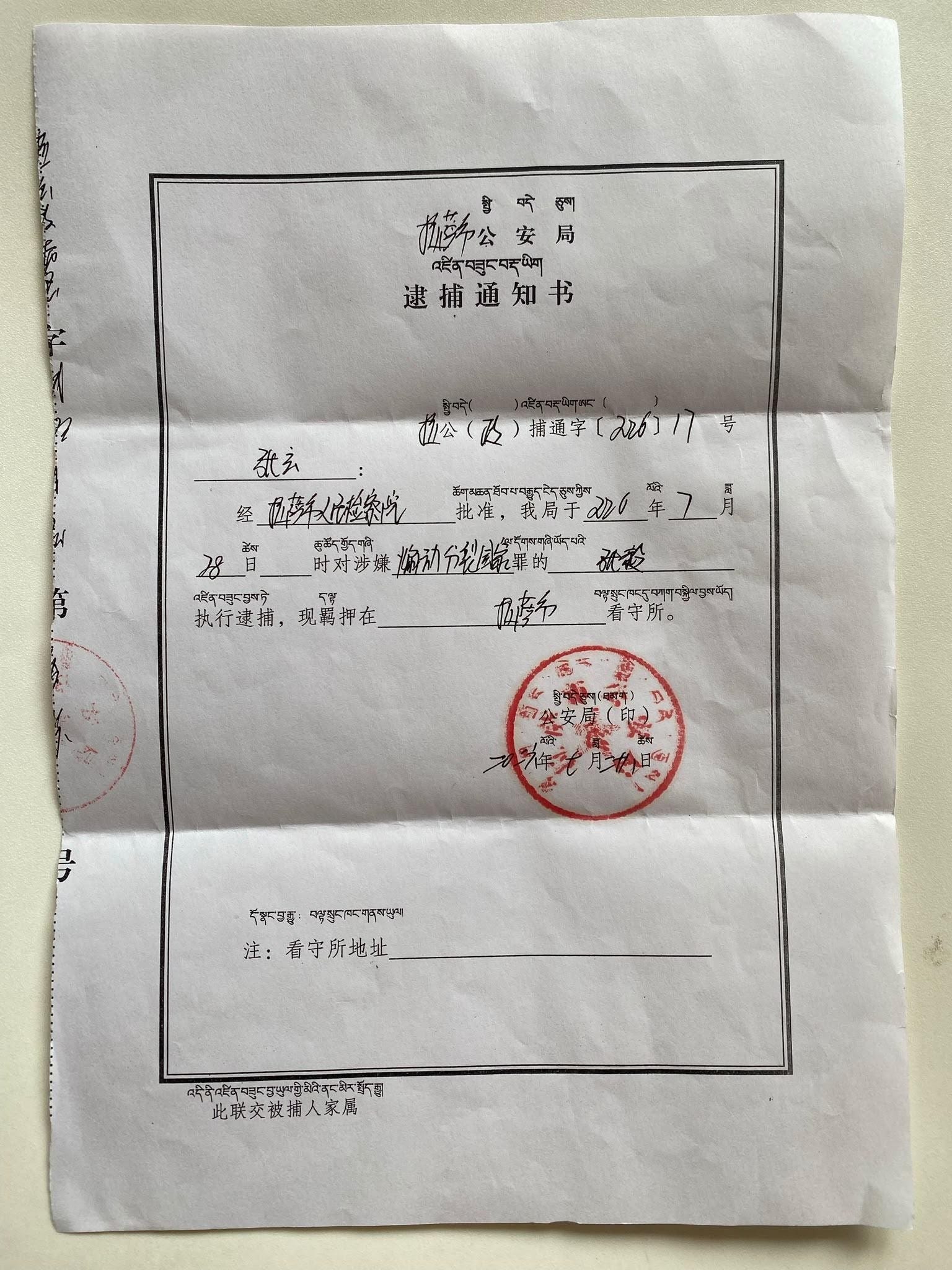
Lawyers hired by the family attempted to visit him, but because such cases are categorized under “endangering state security,” the scope for legal defense is extremely limited. The family also worries that the authorities might impose a “government-appointed lawyer,” severing Zhang Yi’s contact with the legal counsel his family actually trusts.
The pressure quickly rippled from Lhasa back to Wuhan.
In late July, municipal and district state security officers sought out Zhang Yi’s brother. Presenting screenshots of reports published by Human Rights in China and other human rights websites, they interrogated him about whether he was in touch with Zhang Hongyuan overseas and whether he had leaked details of the case. The agents demanded that Zhang Hongyuan “stay quiet on the outside,” “stop exaggerating propaganda,” and warned that he “will have to return to China eventually.”
This is a language the families of Chinese dissidents know intimately: using the safety of loved ones as a tool to gag those who might speak out.
But Zhang Hongyuan read a different message from their visit.
“The fact that they went out of their way to visit over this proves that they saw it, and they care,” he said.
This is exactly why he insists on speaking out publicly. Silence has never guaranteed a father’s safety; it only makes it easier for an unjust imprisonment to carry on in the dark.
The charge against Zhang Yi stems from Article 103 of China’s Criminal Law. In the political rhetoric of the Chinese authorities, the Dalai Lama has long been branded a “separatist,” even though he publicly abandoned the pursuit of Tibetan independence years ago, seeking instead genuine autonomy within the framework of the PRC. In Tibet, merely possessing or displaying his photograph can invite severe punishment.
But even understanding this political backdrop, Zhang Hongyuan cannot accept the fundamental logic behind the charge.
“A tourist in Lhasa showed a photo of the Dalai Lama to someone who didn’t even share his language, someone who was too scared to even look at it—and they say he incited separatism ,” he questioned. “What did he incite? And what did he secede?”
Zhang Yi didn’t organize a rally, he didn’t give a speech, and he didn’t persuade anyone to support Tibetan independence. He simply pulled out a photo of a friend and tried to strike up a conversation with a stranger.
Perhaps what is truly terrifying isn’t the photograph itself, but the fact that in a highly controlled environment, a person still retains a memory that isn’t dictated by orders: he recognizes the man in the photo, and he is willing to let others see it.
“Speaking out is definitely useful”
Zhang Hongyuan is fully aware that the outlook for his father’s case is grim.
Zhang Yi’s involvement in 1989, his three decades of public engagement since, and his son’s political activities abroad could all serve as excuses for the authorities to “settle old scores.” For this reason, the family and lawyers are incredibly cautious, desperate to ensure no unverified claims are used to exacerbate the case.
But caution does not mean silence.
“Speaking out is definitely useful,” Zhang Hongyuan stressed repeatedly.
This statement isn’t born of blind optimism. He knows that an article, a letter, or a public statement might not instantly throw open the detention center doors. But the fact that state security agents ordered the family to stay quiet proves in itself that the authorities do care whether the outside world is watching.
For Zhang Hongyuan, speaking out achieves at least one thing: it ensures his father isn’t silently erased from the world.
Many years ago, he sat in a police station with a pot noodle, telling the officers: “If you don’t let him go, I’m not leaving.” Back then, he was just a child powerless against the state apparatus. All he could do was stay put and let the police know someone was waiting outside the door.
Today, he is separated from his father by national borders, a detention center, and a judicial system that refuses to operate in the light. He can no longer sit in the corridor of the Lhasa Detention Centre and wait, nor can he personally bring his father home.
What he can still do is stay put—only this time, he is standing squarely in the public eye.
“I am campaigning, I am not running away, and I will absolutely not back down,” he said.
It seems Zhang Yi’s life never truly moved past 1989; and Zhang Hongyuan’s upbringing was defined by one attempt after another to bring his father home. Thirty-seven years later, the same force has once again separated this father and son across two different countries.
The woman in Sera Monastery ultimately never got a clear look at the photograph. Yet, because of Zhang Yi’s arrest, the very picture she was too afraid to look at is now being seen by many more.
Inside the photograph, a monk stands beside the Dalai Lama. Outside the photograph, a newly retired man from Wuhan is locked up in Lhasa; and his son is in Europe, repeating his father’s name over and over again.
He is waiting for his father to come home.
This video from Le Monde supposedly has previously unseen footage for from Tiananmen Square in 1989. Is that really the case? https://youtu.be/8PAacUPhhJU?is=TxsCpiTS2ReOZeW1