

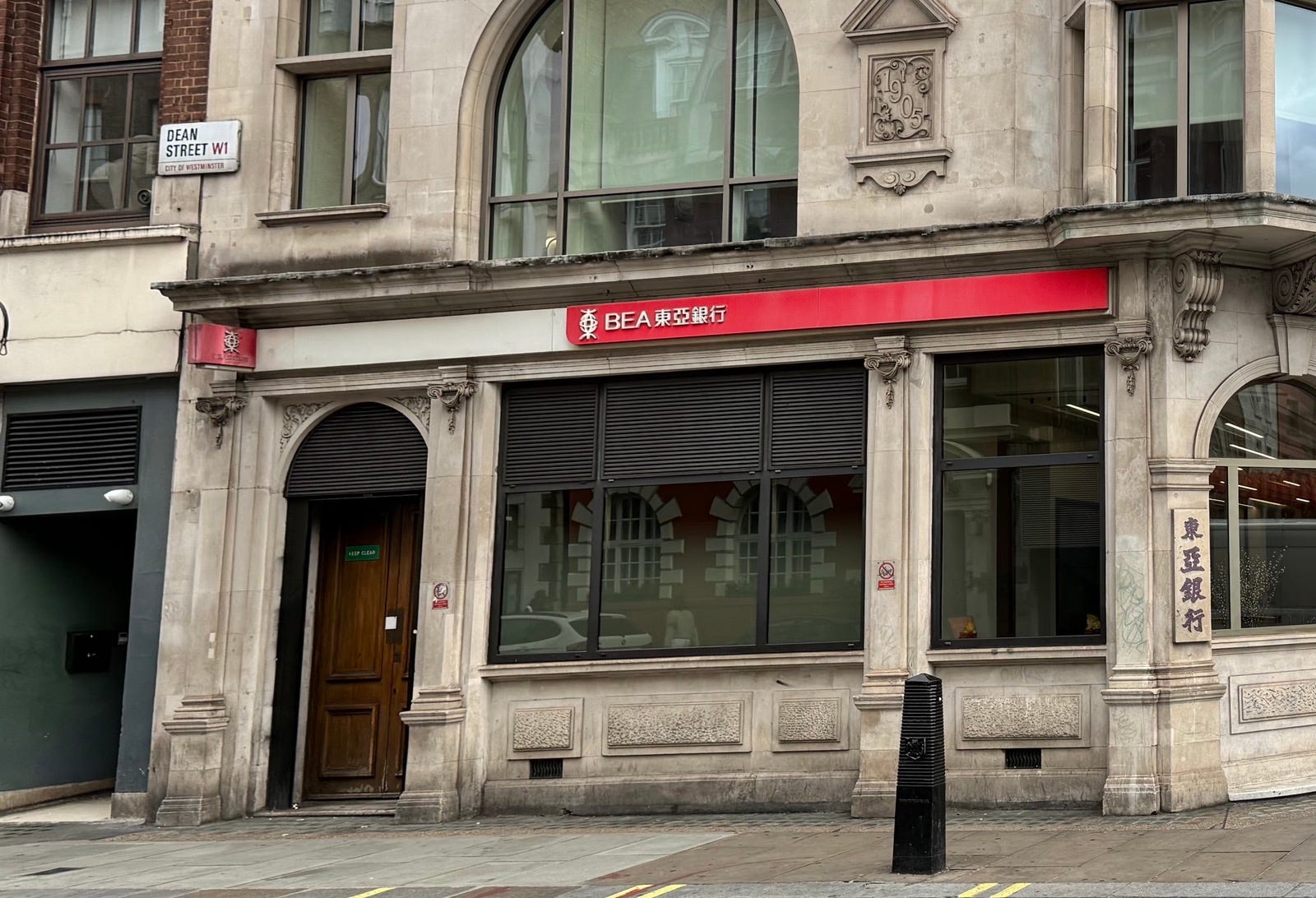
Human Rights in China (HRIC) calls on Bank of East Asia (BEA) to explain why its London branch returned a payment from HRIC to a third-party vendor’s account, just weeks after the Chinese government imposed sanctions against the organization. Despite repeated inquiries, including a formal complaint and an in-person visit to the bank, BEA has refused to explain its decision.
The incident raises serious concerns about whether a UK-regulated financial institution is giving effect to Beijing’s political sanctions against an American human rights organization, and whether third parties are being subjected to scrutiny simply for conducting legitimate business with organizations targeted by China.
On August 5, 2026, the Chinese government placed HRIC on a list of counter-sanctioned U.S. entities, prohibiting organizations and individuals within China from conducting transactions or cooperating with HRIC. Following the announcement, HRIC’s website came under intense and sustained distributed denial-of-service (DDoS) attacks, disrupting its online operations for an extended period. These attacks created significant challenges for HRIC’s ability to communicate with the public and carry out its human rights work.
This subsequent banking incident raises further concerns about the practical consequences of China’s sanctions beyond its borders.
On September 3, HRIC initiated an international wire transfer to an independent business in the United Kingdom holding an account with Bank of East Asia. The payment was not delivered.
BEA subsequently confirmed in writing that the funds had been returned to the remitting bank, but provided no explanation for the decision.
On September 16, HRIC Executive Director Fengsuo Zhou personally visited BEA’s London branch at 75 Shaftesbury Avenue and asked why the payment had been returned. Bank staff declined to provide an explanation, insisting that they would discuss the transaction only with the holder of the receiving account.
HRIC subsequently submitted a formal complaint, asking BEA to explain the grounds for returning the payment and whether the bank maintains restrictions on transactions involving HRIC. In its October 9 response, BEA again declined to explain why the payment was returned. Instead, the bank stated that HRIC was not its customer and that there was therefore no regulatory basis for registering HRIC’s correspondence as a formal complaint. BEA also declined to confirm whether future payments involving HRIC would be processed, stating that each transaction would be considered on a case-by-case basis. The bank then sought to bring the correspondence to a close.
BEA has repeatedly confirmed that it returned the payment, but has refused to explain why.
The incident also had a concerning impact on an unrelated third party. The intended recipient, an independent UK business, had no previous connection with HRIC and was not even aware of the organization before this transaction. Yet, representatives of Bank of East Asia directly questioned the business about its relationship with HRIC, causing considerable alarm and concern. An ordinary commercial transaction thus became grounds for scrutiny of a business with no involvement in HRIC’s human rights activities. To protect the business from any further pressure or repercussions, HRIC will not disclose its identity.
This incident raises serious concerns about financial surveillance and the chilling effect of China’s sanctions beyond its borders. If businesses are questioned about their associations with organizations targeted by Beijing, they may become reluctant to conduct even routine, lawful transactions with such organizations.
The consequences of political sanctions can therefore extend beyond their immediate targets, affecting businesses and individuals who have no political involvement whatsoever.
To provide context regarding the bank itself, Bank of East Asia is headquartered in Hong Kong and maintains extensive operations in mainland China. Members of its senior leadership have held significant positions in China’s political institutions, including the Chinese People’s Political Consultative Conference. This bank has also previously frozen funds belonging to the Hong Kong Alliance in Support of Patriotic Democratic Movements of China, an organization that for decades organized Hong Kong’s annual June 4 Tiananmen commemorations.
These facts make transparency about BEA’s treatment of HRIC particularly important.
The Chinese government’s August 5 sanctions prohibit organizations and individuals within China from conducting certain transactions and cooperation with HRIC. They do not impose obligations on British financial institutions to reject lawful payments involving HRIC.
If Bank of East Asia is applying Chinese government sanctions through its UK operations, this would raise serious questions about the extraterritorial reach of Beijing’s political sanctions and the responsibilities of financial institutions operating under British regulation.
The issue extends far beyond a single returned payment. International banking networks must not become instruments through which authoritarian governments can restrict the lawful activities of human rights organizations across national borders.
HRIC calls on Bank of East Asia to provide a clear explanation of why it returned the September 3 payment, disclose whether the Chinese government’s sanctions against HRIC played any role in its decision, and clarify whether transactions involving HRIC are subject to restrictions within its UK operations.
HRIC also calls on the relevant UK financial regulatory authorities to examine whether Chinese government sanctions are being applied by financial institutions operating in the United Kingdom, and whether such practices are consistent with British law and regulatory obligations.
HRIC will continue pursuing answers through appropriate regulatory and other channels.
A routine financial transaction should not become an occasion for political scrutiny. No human rights organization should be financially isolated by a foreign government’s sanctions, and no business should fear consequences simply for accepting one as a customer.
The freedom to conduct lawful financial transactions is essential to the independence of civil society. Protecting that freedom is an important part of resisting transnational repression.