

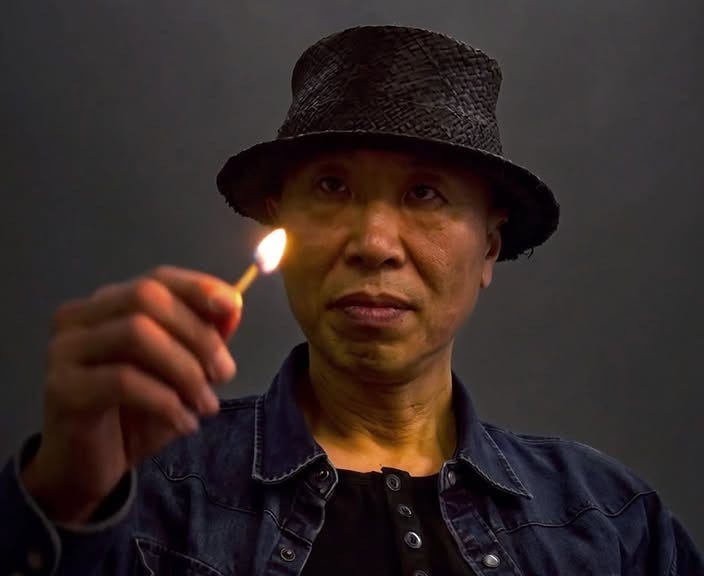
In March 2026, Gao Zhen delivered his closing statement in a one-day, closed-door trial for infringing on the reputation of China’s “heroes and martyrs” with artworks he had created decades earlier, more than ten years before the creation of the very law he was charged with. Below, HRIC has translated the full text of Gao Zhen’s final statement to the court.
On August 25, 2026, Gao Zhen was sentenced to three years in prison.
Read the original text in Chinese here. / 读中文原文。
Gao Zhen: A Helpless Defense and Confession
My Final Statement
Your Honor, Ladies and Gentlemen of the Court:
I thank the presiding judge for granting me the opportunity and time, in accordance with the law, to deliver this “final statement.” Given that I am still a suspect awaiting a final verdict, and in the spirit of the principle that a defendant is innocent until proven guilty, please allow me to present my defense and statement as an artist who holds the Christian faith.
At the suggestion of my defense counsel, and to better exercise the legitimate rights granted to a defendant by the Constitution, I have chosen to present my words in writing so that Your Honor has a relatively detailed and comprehensive reference when making the final ruling.
I am ashamed to admit that as a Christian, I do not fully understand why God has allowed this misfortune to befall me in my frail, elderly years rather than twenty years ago, when I was in the prime of my youth and strength. After all, it is the three allegedly illegal sculptures I created over two decades ago that are the primary reason I have been designated a “criminal suspect” by the authorities and find myself standing in the dock today. Faced with such a vast span of time, I feel perplexed, but I trust there is a deeper meaning here that eludes my immediate understanding.
At this moment, I feel as though I have fallen into a dream with no foreseeable end, or perhaps stumbled into a dramatic experimental theater piece where I am forced to play a villainous role for which I am ill-suited; or else, through some twist of fate, I have become an unwitting participant in a collaborative piece of performance art.
Yet, the reality before me is undeniable and must be faced: I am now standing in the dock.
This situation brings to mind two revered figures bearing the surname “Su”: the ancient Greek philosopher Socrates1 and the great Northern Song Dynasty literary giant Su Dongpo. This is likely because both men, in their respective eras, were unfortunate enough to stand in the dock on trumped-up charges, much like myself. Furthermore, the nature of the accusations against them was essentially similar: nothing related to the pursuit of wealth that the world often covets, rather, they were prosecuted for their words (and artistic creation also falls within the scope of freedom of expression).
The former was charged with “showing disrespect to the state’s gods and corrupting the youth,” while the latter was accused of “criticizing the imperial carriage and harboring malicious intent” (slandering the imperial court). The former, upholding his philosophical concept of “knowing that one knows nothing,” frequently scrutinized the “learned scholars” of his time, who fancied themselves all-knowing, and exposed their ignorance; this offended the intellectual elite, who fabricated charges against him and brought him to court. The latter fell into disgrace during the second year of the Yuanfeng era under Emperor Shenzong of the Northern Song Dynasty; after writing poems such as “Ode to the Cypress,” he was removed from his position by a censor and imprisoned—an event known in history as the “Crow Terrace Poetry Trial” (Wutai Shian), which marked the beginning of literary inquisitions in China.
The former voluntarily renounced the opportunity for exile—a legal option at the time to escape the death penalty—and refused a final offer from his wealthy friend Crito to help him flee, instead calmly facing the Athenian court and its grand jury of five hundred citizens to deliver his “final statement” (recorded in Plato’s Apology). At the conclusion of his address, he left behind profound parting words: “The hour of departure has arrived, and we go our separate ways—I to die, and you to live. Which is better? Only God knows.” He then drank the cup of poisoned wine that would cause future generations to sigh with regret, meeting death with composure and bidding farewell to a world fraught with turmoil.
The latter, however, was fortunate enough to have Emperor Shenzong personally review his case file shortly after his imprisonment. The Emperor issued an imperial decree stating, “A poet’s words are of no concern to Ourselves,” ordering his release. Although demoted to a post in Huangzhou, Su went on to pen masterpieces that have captivated readers and endured through the ages: the First Ode on the Red Cliff and the Second Ode on the Red Cliff.
Coincidentally, when Socrates faced charges and when I stood here in the dock, we were both elderly men nearing seventy, with young children at home who still required our care and companionship. Yet, he could calmly let go and face death with magnanimity, whereas I, mindful of my young child waiting day and night for my return, found myself yearning desperately to go home and reunite with my family after just over half a year in prison. This is surely because, in my heart, love, freedom, and the responsibilities of fatherhood far outweigh any adherence to abstract ideologies or the pursuit of posthumous renown.
Your Honor, ladies and gentlemen, and fellow citizens: please forgive me for recounting these historical episodes before addressing the specifics of the case at hand. I do so with no intention of basking in the reflected glory of these sages or seeking cheap fame.
I am under no illusion regarding my own standing compared to these two sages, the former a prophet sent by God during the “Axial Age,” a foundational figure of Western and indeed global civilization, holding a significance for China and the world comparable to that of our own sages Laozi, Confucius, and Mencius; the latter a deeply influential poet, painter, and calligrapher in our native culture. I, however, am merely an admirer of theirs—a contemporary artist weathered by the passage of time, awaiting the judgment and ultimate placement that history alone can bestow.
I mention them not only because of the natural association drawn from our shared experiences of falling afoul of authority, but also to remind everyone—myself included—that we are but wayfarers in the flow of time and the evolution of history. The words and deeds of today determine the roles we will play and the positions we will hold in future histories.
Whether our actions today can withstand the scrutiny of history depends on whether we possess an innate conscience, the professional ethics demanded by our respective roles, and the strength of character, moral courage, and sense of justice to transcend worldly interests.
Using history as a mirror is a spiritual safeguard that prevents us from doing anything today that would disgrace our dignity and honor.
Therefore, I respectfully and humbly remind Your Honor, who holds the power today to determine the defendant’s guilt or innocence and the nature of any offense, that you embody the fairness of the law. Regarding this case specifically, I respectfully request that you rigorously review the prosecution’s indictment to determine whether charging me with the crime of “infringing upon the reputation and honor of heroes and martyrs”—an offense introduced into the Criminal Law in 2021—based on sculptures I created between 2005 and 2009, a period when this specific crime did not yet exist, is in fact compliant with the law?
I earnestly request that you strictly scrutinize the prosecution’s indictment. The prosecution charges me with the crime of “infringing upon the reputation and honor of heroes and martyrs,” a provision added to the Criminal Law in 2021—alleging that sculptures I created between 2005 and 2009 (a time when this specific crime did not yet exist) constitute a criminal offense. I ask: Is this charge compliant with regulations? Does this violate the fundamental legal principle that “what is not prohibited by law is permitted”?
It is the obligatory duty and honor of Your Honor, as the presiding judge in this case, to render a fair and impartial verdict.
Below, I present the necessary and specific arguments and statements in response to the indictment served upon me.
Let us first look at the opening paragraph of the indictment, which identifies my place of residence and status: “The defendant, Gao Zhen... currently resides at Factory Building 7-A, Baishi Jingu Industrial Park, Yanjiao Development Zone, Sanhe City, Langfang City, Hebei Province, and serves as the Supervisor of Sanhe Ruiyi Trading Co., Ltd.”
Regarding my address: The Provisions on the Handling of Criminal Cases by Public Security Organs clearly state that “A place of habitual residence refers to the location where a citizen has continuously resided for more than one year after leaving their place of household registration.” Based on this definition, my place of habitual residence is a location in New York, USA, not the “Yanjiao Baishi Jingu Industrial Park” cited in the indictment.
That location was merely a temporary residence where I stayed for about two months to organize my belongings after returning to China with my wife and children in June 2024. In fact, I immigrated to New York, USA, as an “individual of extraordinary ability” in 2012. Although I have frequently traveled between New York and Beijing over the past decade or so, whenever I returned to China, I primarily stayed in the 798 Art District in Beijing. I never treated the factory building at Baishi Jingu Industrial Park as a place of habitual residence. Its actual function was simply a warehouse for storing items, including artworks.
Therefore, I have reason to suspect that the prosecution designated this location as my habitual residence in order to resolve issues regarding jurisdictional authority over the case.
Next, let us consider the designation of my identity as “Supervisor of Sanhe Ruiyi Trading Co., Ltd.”
I had never heard of this “Supervisor” role before, and to this day, I remain unclear as to what such a position actually entails. In contrast, my identity as an artist is widely known. Given the prosecution’s misidentification of my role, it is necessary to briefly outline my artistic career:
In 1978, following the Cultural Revolution, I was admitted to the Shandong University of Arts and Design. Upon graduating in 1981, I was assigned to the Jinan Mass Art Museum to provide art instruction. Shortly thereafter, I transferred to the Jinan Painting Academy (now the Jinan Art Museum) to pursue professional artistic creation. I became the youngest professional painter at the academy during my twenties and have continued to engage in creating modern and contemporary art ever since, up until my retirement in 2016.
My work has been exhibited in museums, galleries, and other art spaces across the globe. It has been featured in significant academic publications such as A History of China Modern Art, History of Contemporary Chinese Art, A History of Art in 20th-Century China, and A History of Ideas in Pioneering Contemporary Chinese Art. Furthermore, several of my pieces are held in the collections of renowned institutions, including the Centre Pompidou in France and the San Francisco Museum of Modern Art in the United States. These facts amply demonstrate that my true identity is that of an artist, not a “Supervisor” for some company.
What raises questions is that since my detention on August 26, 2024, the investigating officers have interrogated me more than thirty times. They informed me that they had conducted investigations at both the Jinan Art Museum (my former workplace) and my former art studio in Beijing (in the 798 Art Zone), and were fully aware that I am, in reality, an artist.
How, then, after ten months of investigation, could they fail to acknowledge my true identity in the indictment, choosing instead to fabricate the role of “Supervisor”?
When considering the context of the indictment, it is evident that the prosecution identified my address as the Baishi Jingu Industrial Park in Yanjiao and labeled my role as “Supervisor” not merely to establish procedural jurisdiction. Rather, the intent was to deliberately strip away my identity as an artist. By doing so, they sought to portray the incriminated artwork as the “malicious creation” of a non-artist harboring “resentment,” thereby substantiating the “fact” that I had committed the crime intentionally.
In my view, public security, procuratorial, and judicial organs, as state institutions charged with maintaining public order and punishing unlawful acts, ought to operate based on principles of seeking truth from facts and maintaining objectivity and impartiality. They should base their actions on facts and the law, objectively and fairly determining whether a defendant is guilty and what offense has been committed; they must not allow subjective biases to lead to erroneous judgments, the fabrication of “facts,” or even the creation of a specific type of “criminal.”
Acting in such a manner not only violates the contemporary principle of the rule of law but also risks creating unjust, false, or wrongful cases reminiscent of the Cultural Revolution, thereby stripping the current legal system of its due dignity. The catastrophe of the Cultural Revolution serves as a cautionary tale that must be heeded.
The second paragraph of the indictment states: “The investigation of this case was concluded by the Sanhe Public Security Bureau. On November 28, 2024, the case was transferred to this Court for prosecution, with the defendant, Gao Zhen, accused of infringing upon the reputation and honor of heroes and martyrs. After accepting the case... this Court heard the opinions of the defense counsel... The case was returned to the public security organ for supplementary investigation twice due to unclear facts and insufficient evidence, and the review period for prosecution was extended three times due to the case’s gravity and complexity.”
However, during this period, my defense counsel twice applied for my release on bail pending trial, citing my advanced age, frailty, and ailments affecting my waist and legs that hindered my mobility, but these requests were denied. Counsel also proposed that my sentencing align with precedents for similar cases, but this suggestion was likewise rejected.
This demonstrates that while the prosecution “heard” the defense counsel’s opinions, it did not “adopt” them. Therefore, it is misleading to state broadly that the defense’s opinions were “heard,” as this might create the false impression that the defense’s position aligned with that of the prosecution.
The third paragraph of the indictment states: “It has been legally established that between 2005 and 2009, the defendant Gao Zhen, harboring resentment toward a former state leader, conspired with others at a studio in Beijing’s 798 Art Zone to maliciously create a large number of sculptures that distorted and caricatured the heroic image of said leader. These works were then shipped overseas for exhibition and media coverage under the name ‘Gao Brothers.’ Subsequently, Gao Zhen moved the aforementioned sculptures to the Baishi Jingu Industrial Park (Factory Building 7-A) in the Yanjiao Development Zone, Sanhe City, Hebei Province, for storage.”
I acknowledge that the details regarding the timing and location of the creation of the sculptures, the timing of the exhibitions, and the subsequent storage site are substantially accurate; I myself also provided this same account during successive interrogations by the public security authorities.
However, I strongly disagree with the characterizations used in the indictment, such as “harboring resentment” and “distorting and caricaturing.” Such language is highly subjective and arbitrary; it amounts to an attack on my underlying intent based on a presumption of guilt, rather than objective, rigorous legal terminology.
More importantly, this description is fundamentally at odds with my true motives and mindset as a professional artist when creating these works, as well as the artistic concepts ultimately embodied in the pieces.
Below, I offer a more specific rebuttal regarding the inaccuracies in this paragraph.
Let us first address the term “a large number.” This presumably refers to the work titled Miss Mao. Admittedly, in my quest to create a satisfactory Pop Art piece with distinct local characteristics, I did invest a great deal of time and material into experimentation and comparison. I produced various prototype versions in different sizes to determine which effect best aligned with my original creative vision.
However, for an artist, no matter how much effort is expended or how many experimental pieces are produced during the creative process, only one is typically selected as the definitive version for exhibition within the art world. This was the case when the work was exhibited at the Kemper Museum of Contemporary Art in Kansas, USA, where only a single piece was displayed, rather than cluttering the gallery with every experimental model and unfinished prototype.
This follows the same logic as a manufacturer that invests significant resources in designing and comparing multiple prototypes to ensure high product quality, ultimately selecting just one model for market release.
Therefore, it is highly inappropriate for the indictment to conflate a large inventory of experimental pieces, defective items, and semi-finished goods that were awaiting further processing with a “large number” of criminal acts on my part.
As for the other two accused works, The Execution of Christ and Mao’s Guilt, each exists as a unique piece upon completion; there is simply no basis for describing them as a “large number.” The confusion likely stems from the fact that Execution is a large-scale installation composed of eight individual sculptures; its sheer physical size created the misleading impression of a “large quantity.”
Thus, the term “large number” used by the prosecution is not only imprecise but also risks misleading the court into imposing a harsher sentence.
Next, I will present a detailed defense against the allegations of “harboring resentment,” “malicious creation,” and “distortion and vilification,” explaining the creative concepts behind the specific works in question.
Let us begin chronologically with Miss Mao, created between 2005 and 2006.
The primary form of this work derives from a cartoon doll (a “readymade” object) sold in stores at the time. Its hairstyle borrows from a widely recognized public figure, while the addition of Pinocchio’s long nose and a pair of female breasts completes the composition—a work synthesized through the deconstruction and combination of these four elements.
Please note that the use of readymades and public imagery for symbolic transformation that is infused with the artist’s own conceptual intent is a common creative method among contemporary artists worldwide and a hallmark characteristic of Pop Art.
The most classic example is the French artist Marcel Duchamp, who drew a mustache and goatee on a print of the Mona Lisa, thereby pioneering conceptual art. Similarly, the American Pop Art master Andy Warhol transformed portraits of celebrities like Marilyn Monroe and Mao Zedong into mass-reproducible cultural symbols.
Within China’s renowned “Political Pop” movement, the imagery of “former state leaders” (as cited in the indictment) was a primary resource used by artists to represent the cultural characteristics of a specific era. My work Miss Mao represents one such expression within this movement.
In terms of artistic methodology, this figure accurately reflects and expresses the type of complex cultural characteristics of the “post-Mao era” (the period following the Cultural Revolution): it retains traces of past political imprints while simultaneously embodying an atmosphere that was relatively relaxed, absurd, and even humorous.
In short, Miss Mao is an ambiguous artistic figure. I deliberately rendered it in a female or cartoon-like form precisely to avoid having it rigidly equated with any specific real-life individual.
The indictment’s direct equation of the figure with a “former state leader” is not only a serious misinterpretation but also diminishes the work’s conceptual significance—the figure actually represents every Chinese person who lived through that era and was shaped by its prevailing ideologies.
Consider next the works The Execution of Christ and Mao’s Guilt, created between 2007 and 2009.
Both works draw their creative inspiration from the film and television performances of character actor Gu Yue, as well as the scandal surrounding his solicitation of a sex worker, and were created using him as the model.
The Execution also draws upon a visual precedent: the famous painting The Execution of Emperor Maximilian by the French Impressionist pioneer Édouard Manet. I adopted Manet’s classic composition, replacing the original soldiers with seven “lookalike” actors modeled after Gu Yue, all aiming their weapons at a figure of “Jesus Christ” based on a young French man.
The decision to present Gu Yue in the plural, as seven figures, was intended to signal that the image does not specifically refer to the “great figure” he famously portrayed; otherwise, a single gunman would have sufficed.
For a contemporary artist, it is a legitimate artistic pursuit to revitalize art history classics and provoke critical thought through “parody” and “appropriation.”
I hoped that by juxtaposing “Jesus Christ” with the ambiguous figure of Gu Yue—who embodies the roles of ordinary person, celebrity, and lookalike actor—I could prompt viewers to reflect on grand themes such as the relationship between the divine and the human, cultural differences between East and West, violence versus peace, and confrontation versus reconciliation.
How could a work born of such deep artistic contemplation possibly be accused of being “maliciously fabricated” or a “distorted caricature”?
Setting aside the question of whether the work’s model is Gu Yue or a “former national leader,” I urge the prosecutor to compare it with historical footage from 1962 of the relevant leaders handling firearms during the “Grand Military Skills Competition” initiated by Luo Ruiqing. Does my work show any signs of “vilification” in its physical depiction of the subject?
If an artist truly intended to maliciously caricature someone, wouldn’t the concise, potent medium of political cartoons be a far better choice? Why expend nearly three years—along with immense human and material resources—to create a large-scale, realistic sculpture?
This brings to mind an incident from the past: shortly after this work was completed in 2009, I placed a sculpture of the gun-wielding Gu Yue on the ground floor of “The High Place” coffee shop (在树上咖啡) in 798 Art District. I then invited Officer Hou from the police station next door to take a look and determine whether the display was appropriate. After viewing the work, Officer Hou and his superiors all stated: “There is no distortion or vilification; there are no issues.”
Why, then, after seventeen years, have the Sanhe Public Security Bureau and the prosecutor chosen to accuse this same work of “malicious distortion and vilification”?
At a recent pre-trial conference, the prosecutor remarked: “The numerous sculptures and photographs in this case either incorporate elements characteristic of the hero’s image or directly replicate that image.”
This very phrasing demonstrates that there is no “distortion or vilification” in my work; after all, if the work is a “direct replication,” it is impossible for it to result in vilification. This suggests that the claim of “vilification” is merely the prosecutor’s subjective bias rather than an objective fact about the work; such a self-contradictory accusation in the indictment amounts to nothing less than a frame job.
Regarding the creative concept behind Mao’s Guilt: This work was also inspired by rumors surrounding the actor Gu Yue and was modeled on him.
As a character actor known for portraying the “Great Leader,” Gu Yue’s scandals not only damaged his own reputation but also deeply hurt the feelings of admirers who had inextricably linked him with the image of the leader he portrayed (the prosecutor’s view of my work reflects this same deep-seated association).
Artistically depicting Gu Yue in an act of repentance creates a rich artistic tension; at the same time, it allows me, as a Christian, to express a sense of repentance for the “original sin” shared by all humanity, as well as to offer an indirect reflection on the history of the Cultural Revolution.
Kneeling in repentance is the most devout posture a Christian can adopt. It is far removed from the “harboring of resentment” alleged in the indictment. On the contrary, creating this work was, in a sense, an act of benevolent intercession. That is precisely why the figure’s expression was sculpted to appear so solemn, profound, and realistic.
Admittedly, once an artwork is completed, it takes on a life of its own: some have criticized the piece for potentially “glamorizing” the subject (arguing that an atheist could not possibly offer such devout repentance), while others have drawn parallels to West German Chancellor Willy Brandt’s “Kniefall von Warschau” (Warsaw Genuflection) or perceived a message of Christian forgiveness.
Art inherently allows for diverse interpretations. For the prosecutor, who is completely unfamiliar with contemporary art, to level such baseless accusations driven by ideological prejudice is a clear overreach.
Although their aim is to incriminate me, I choose to emulate Jesus Christ on the cross and pray that God forgives them, for “they know not what they do.”
I would even like to thank the prosecutor for using such extreme measures to reignite the latent power of these long-forgotten early works.
At this point, it is necessary to emphasize a fundamental principle: evaluating avant-garde experimental art requires specialized expertise. Evaluations of such art should be left to art critics and scholars, rather than being subjected to the dogmatic, politicized characterizations of individuals lacking this professional background, or even the use of criminal penalties to deprive artists of their freedom.
Relevant provisions of the Criminal Procedure Law of the People’s Republic of China grant the accused and their defense counsel the right to request the testimony of individuals with specialized knowledge. This was precisely why we requested during the pre-trial conference that the renowned art critic Dr. Zhu Qi appear in court to provide professional testimony.
Furthermore, the fourth paragraph of the indictment alleges that I, “in collusion with others, transmitted photographic images of the aforementioned sculptures to the X platform for online dissemination... and authorized others to use the images for a book cover.”
Regarding this allegation, I have repeatedly stated: I never authorized Mr. Rong Wei of New York’s Boden Books to use the image for the cover; in fact, I explicitly rejected his request. My attendance at the award ceremony was precisely for the purpose of addressing this matter in person. The testimony from Mr. Rong Wei, as submitted by my defense counsel and certified under the Hague Convention, fully establishes my innocence.
As for the X platform account, it was registered by my younger brother, Gao Qiang, many years ago. I have never posted the images in question on that platform. A recent public statement by Gao Qiang corroborates this point.
The indictment’s claim that these actions “seriously infringed upon the reputation of a former state leader and harmed the public interest” is purely baseless speculation.
If these works which were created twenty years ago truly posed such a grave threat, why did the authorities take no action at that time? By imposing a harsh sentence now and thereby thrusting these works back into the international media spotlight, are they not artificially creating even more severe “harmful” consequences?
I respectfully urge Your Honor to consider the following questions:
Is there any clear legal provision supporting the classification of a historical figure who passed away half a century ago as an untouchable “hero or martyr”?
Do the portrait and privacy rights of such a historical and public figure supersede the public’s right to artistic expression and historical evaluation?
Is a specialized actor (such as Gu Yue) legally equated with the actual leader he portrays?
In all modern civilized nations, public authority must be subject to the supervision and criticism of the citizenry—criticism that naturally encompasses artistic forms.
Today, the grand vision of the state emphasizes the “rule of law” domestically while advocating for “building of a community with a shared future for mankind” internationally. Yet, if the rule of law cannot be genuinely implemented at home, such grand international aspirations remain out of reach.
Although I have lived abroad for many years, I continue to yearn for the realization of the true rule of law in my homeland.
The rule of law entails equality before the law; yet, because this case involved a “high-ranking” revolutionary martyr (as Prosecutor Li put it), the prosecution sought to deviate from the customary sentencing practice for similar cases—which typically results in a term of less than one year—and instead pushed for the maximum three-year sentence. This clearly violates the principle of legal equality.
Moreover, the use of criminal penalties is entirely inappropriate for using artistic reflection to address the actions of historical figures who committed grave errors during their lifetimes (such as instigating the Cultural Revolution).
During the back-and-forth proceedings of this case, Prosecutor Li, who was in charge of the matter, told my defense lawyer that the case was highly sensitive and beyond his decision-making authority, requiring higher-level consultation. However, he implied that if the sentence were around one and a half years, he would advise me to accept a plea deal.
Persuaded by my lawyer and family, and considering that I had already been detained for over six months—being elderly and frail, with a young child in urgent need of my presence—I reluctantly stated: although I maintained my innocence, I would accept a plea deal in order to reunite with my family sooner, provided the sentence followed the precedent for similar cases (around one year). Prosecutor Li sincerely agreed to report this proposal.
Yet, a few days later, Assistant Prosecutor Sun Yang abruptly announced to me that the sentence sought was three years. When I questioned how the policy of leniency for pleading guilty and accepting punishment was actually being applied, she shouted irrationally: “Pleading guilty and accepting punishment means three years! If you don’t plead guilty, the sentence will be even higher!”
I was deeply shocked to see a nation’s statutory sentencing laws and policies of leniency interpreted and manipulated in such a crude manner.
To speak honestly: I have reached the age of seventy, I have endured the hardships of the Great Famine and the humiliations of the Cultural Revolution, I have performed grueling manual labor, taken risks, and experienced both love and pain; and as such, I feel my life has been fulfilled.
If it were not for my young son, who is only six or seven years old, weeping day and night and begging God to let his father come home, and my reluctance to let my children suffer the same pain of losing a father that I endured in my own childhood—then, for me personally, what would a few extra years in prison matter if it meant standing by my convictions?
I was willing to humble myself for my young son’s sake and make a compromise against my conscience just this once, but the prosecution denied me that opportunity. So be it! Spending two more years in prison to preserve my lifelong integrity and conscience is worth it!
In this era rife with taboos, cowardice constantly torments the hearts of those with a conscience. Now, having finally “completed the lesson of imprisonment,” I will no longer feel that inexplicable sense of shame.
This case is not, at its core, an ordinary criminal case, but a political case akin to the “Crow Terrace Poetry Trial” that befell Su Dongpo.
If the court rules to imprison an innocent artist, or even impose the maximum possible sentence, it would not uphold the dignity of the law. Instead, it would tarnish the nation’s image of “governing the country according to the law” and potentially set a terrible precedent for “artistic imprisonment” in 21st-century China.
This would leave a stain on history that the judge presiding over this case would surely not wish to bear.
Finally, it must be emphasized that the works in question were created against a historical backdrop where “reflection on the Cultural Revolution” was advocated from the top down. At that time, Ba Jin called for the establishment of a “Cultural Revolution Museum,” and Premier Wen Jiabao repeatedly warned against a resurgence of the Cultural Revolution. These works were the inevitable products of that specific historical period, which is precisely why there was no action against them back then.
In summary, the prosecution’s charges are based on subjective speculation and ideological bias, standing in stark violation of the fundamental principle that “everything not prohibited by law is permitted.” Therefore, I respectfully urge Your Honor to exercise keen discernment and render a just verdict.
Please forgive me for taking up so much time to read this lengthy statement.
I do this not only to secure my own early release, but also to ensure that other artists do not face charges and imprisonment for similar acts of free expression; and, even more importantly, so that my fellow citizens may all enjoy freedom from fear within a true rule-of-law framework.
Here, I wish to quote the famous words of Mr. Hu Shih: “Striving for your own freedom is striving for the freedom of your country!”
Regarding the final verdict, I shall follow the example of the ancient sage Socrates and calmly accept whatever fate holds in store.
Allow me to conclude my statement with a simple prayer, in the manner of a Christian:
Merciful Heavenly Father, please hear the plea of an innocent artist and prisoner; may the Lord Jesus Christ bestow special grace, mercy, and comfort upon my young children; I humbly ask the Lord to show mercy to me and to my fellow countrymen who are suffering alongside me; may the Lord forgive our debts and sins, and may Your will be done on earth as it is in heaven, forevermore.
Amen!
Thank you all!
Respectfully submitted by the defendant, Gao Zhen
Written on August 28, 2025
Revised on March 28, 2026
Translator’s Note: Socrates is transliterated in Chinese as su ge la di.