

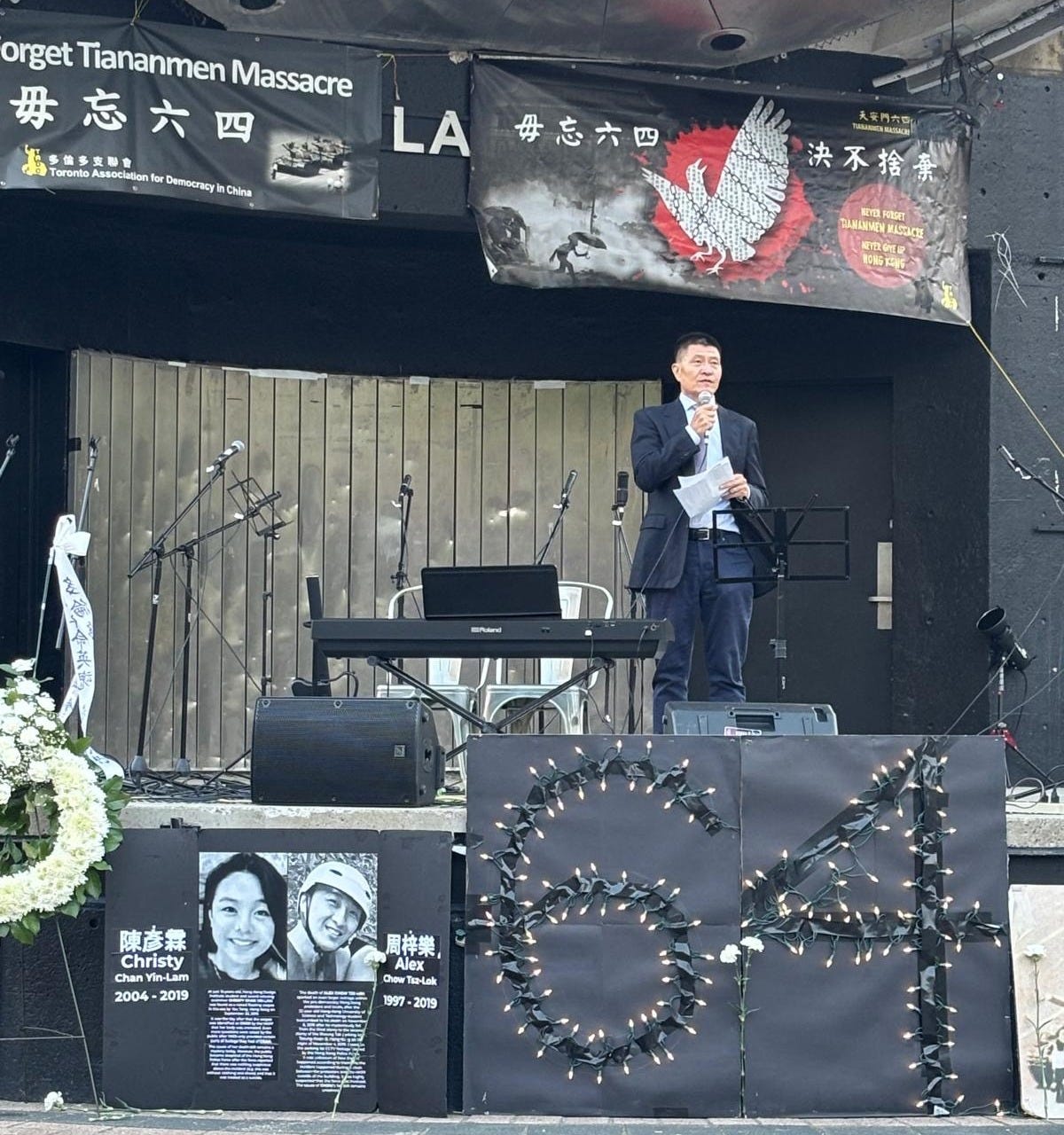
On May 30, Zhou Fengsuo, Executive Director of Human Rights in China, spoke at a commemoration event in Toronto marking the 37th anniversary of the June Fourth Tiananmen Massacre. HRIC has published his translated statement below, or find the full speech here on YouTube with English subtitles.
Thank you, everyone. Being here in Toronto today, I feel a deep sense of familiarity, of being among friends. At such a painful moment, this is a rare place where one can find comfort and see hope. Because we are gathered here, and there are so many of us together, who stand with Chow Hang-tung in prison, stand with the Tiananmen Mothers, and stand with the many who died that year.
I want to thank the Toronto Association for Democracy in China, and thank the pro-democracy groups here for their unwavering perseverance over so many years. Toronto is one of the most important cities in the world for commemorating June Fourth. So we must remember that anywhere—just as Victoria Park once was—such commemorations command the attention of the whole world.
Thirty-seven years ago, I was in Tiananmen Square. On the night of June 3rd, I heard gunfire from every direction, and I saw the tanks come charging in. In the end, I was among the last group of students driven out by the tanks.
I also saw more than forty bodies in a hospital, including students from Tsinghua University like me. The Fuxing Hospital beside Chang'an Avenue was already overflowing with the dead and wounded, and so they could only lay the fallen—those heroic martyrs—in the bicycle shed by the street.
For me, such moments, such an hour, I will never forget. To all those who died, I owe a duty. That is why, every year, whenever there is a chance to commemorate June Fourth, I am certain to take part.
We commemorate here today because so many of the dead are still denied justice. We commemorate today, too, because so many people are still holding firm—holding firm around the world, holding firm in mainland China, holding firm inside the prisons of Hong Kong.
I must mention Xu Guang today. He was a student in 1989, and he was sentenced to four years simply for commemorating June Fourth. When he came out of prison, he had suffered so much torture that he could no longer stand. Yet even so, the message he sent out was this: "For democracy and freedom, we have no regrets." This is what commemorating June Fourth means. For all of us who lived through those events, our most important mission is the democratization of China.
As we commemorate June Fourth in Toronto today, there is another person I especially need to mention: Dong Guangping. He was originally a police officer within the system, and his family was what the Communist Party calls a cadre family. But between justice and evil, he chose justice. Again and again he spoke out for the dead, spoke out for the truth of June Fourth, and was imprisoned four times. Refusing to submit and seeking freedom, he once fled to Thailand and to Vietnam, only to be arrested and sent back to mainland China. Just days ago, in a raft he built himself, he crossed the sea for more than thirty hours to reach South Korea. We are deeply grateful to Canada for taking in his family, right here in Toronto. We hope that people like Dong Guangping can be reunited with their families soon. I hope that next year he can be here among us, free to commemorate June Fourth, never again to be seized by the Communist Party.
There is another important reason we commemorate June Fourth: because the Communist Party wants us to forget. They use every kind of method to erase people's memory. Yet despite this, every year we still see more of the truth of June Fourth emerge—more witnesses, more photographs, more documents.
Over this past year, the single most important piece of evidence about the truth of June Fourth is the six-hour video of the courtroom trial of the general who defied orders, Xu Qinxian. Anyone who has not seen it must watch it; it is profoundly important.
Today, the CCP’s military is also a threat to world peace, especially to Taiwan. At such a critical moment, we also call on more military personnel of conscience to refuse to be their lackeys, to refuse to carry out such orders.
Of course, in commemorating June Fourth today, we owe our greatest thanks to the people of Hong Kong. Because of Hong Kong’s thirty-plus years of commemorations in Victoria Park, the world today still remembers June Fourth.
We owe our deepest thanks to the heroic leaders of the Alliance, especially Chow Hang-tung. Back then, she was just a little girl, but today, she is the finest embodiment of the spirit of ’89 and June Fourth. We, as those who lived through it, pay tribute to Chow Hang-tung.
Today’s Hong Kong, in the brutality of its rule, has in fact surpassed the mainland itself. Chow Hang-tung, in prison, faces a sentence that may have no end in sight. Yet at every opportunity, she raises her voice. When Victoria Park is dispersed and commemoration becomes impossible, she turns the courtroom into Victoria Park, recounting the truth of history there, speaking out for the Tiananmen Mothers.
With people like her, I feel that the ideals pursued by those who perished in ’89 are still alive. With people like her, what reason do we have not to commemorate June Fourth overseas?
So her example tells us: No matter how the CCP’s tyranny imprisons people’s bodies, it cannot imprison their conscience.
June Fourth belongs not only to the past, but to today—to every political prisoner, to every journalist who refuses to be silent, to everyone who speaks the truth. As long as we keep persisting, keep commemorating, the ideal of a free and democratic China will endure.
Our actions will one day advance China’s democratization, and a democratic China will be the greatest gospel for this world. Thank you.


