

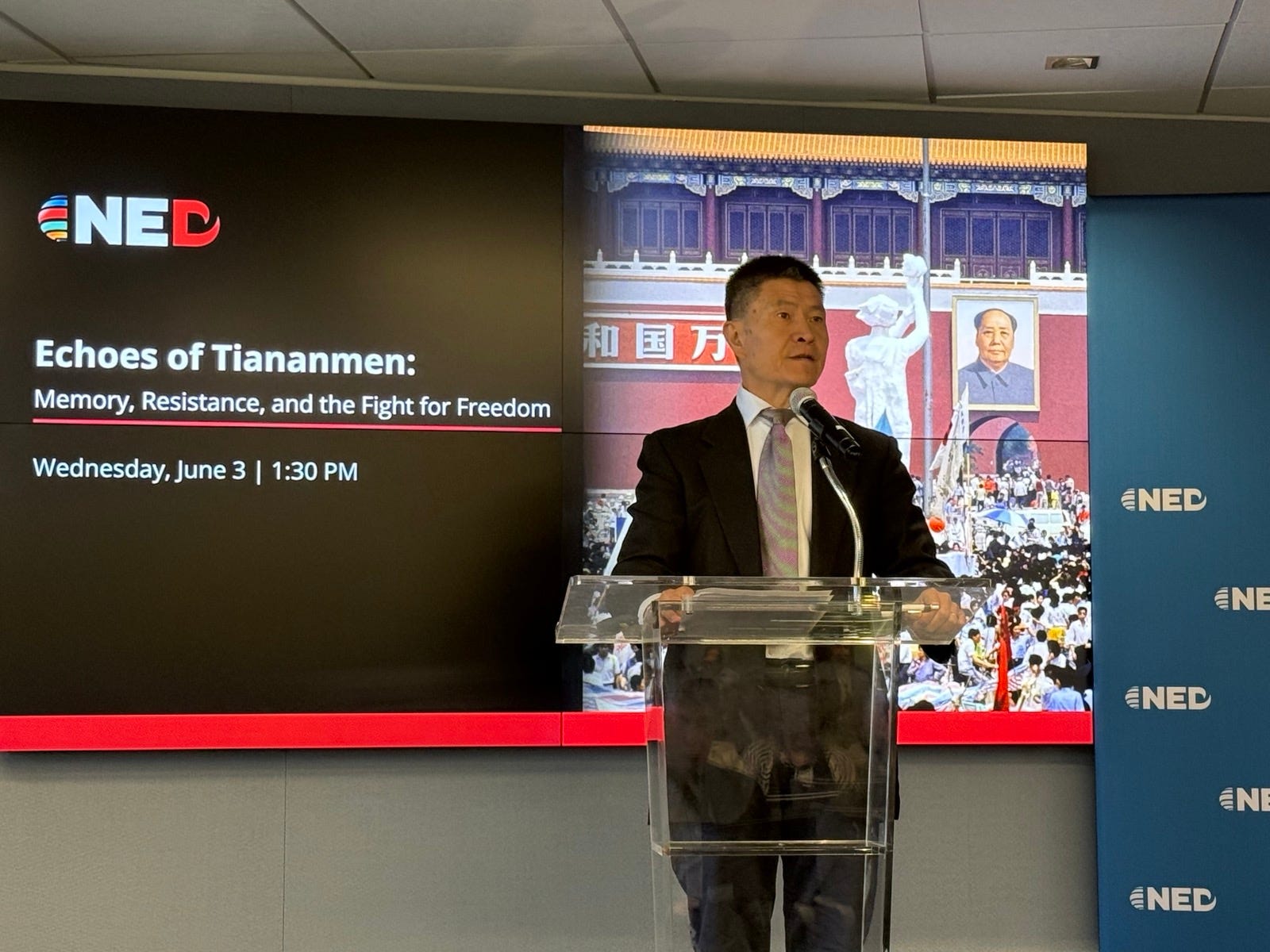
Watch here or read the full speech below.
Thank you all for coming.
Thirty-seven years ago, at this very moment, I was at the center of Tiananmen Square, by the Monument to the People’s Heroes. I heard gunshots coming from all directions of Beijing. A peaceful Beijing, which was so dear to millions of its citizens, was under siege by countless troops. I saw tanks rushing in. I was among the last to leave Tiananmen Square.
Afterward, I saw dozens of bodies inside and outside of Fuxing Hospital. Located on Chang’an Boulevard next to Muxidi, the hospital was completely overwhelmed by the dead and the injured. Because there was no more room inside, many of the victims had to be laid outside in a bicycle shed.
For me, this was just the beginning—a moment I will never forget. To those who died, and to the Tiananmen Mothers, I owe a lifelong duty.
We gather today because those who sacrificed their lives are still denied justice. We gather because people continue to hold firm, both in China and around the world. Today, I am receiving many messages from people inside China, sharing how they are commemorating this moment. Just now, for example, KFC’s “Crazy Thursday” became censored on Chinese social media because young people are using the occasion to commemorate Tiananmen.
We remember individuals like Yin XuAn, a political prisoner who was sentenced to four years in prison simply for commemorating the Tiananmen Square Massacre. He was tortured in prison, and by the time he was released, he was terminally ill. Yet, because he refused to be silenced, he was forcibly disappeared again, and we have not seen him since.
We remember Xu Guang from Hangzhou. He was a student protester in 1989 and was also sentenced to four years in prison. When he was recently released, he had been tortured so severely that he was too weak to stand on his own. Yet, we still heard his defiant message: “For democracy and freedom, our generation must fight on. There are no regrets.”
This is what commemorating June Fourth means. For those of us who lived through those events, our mission remains unchanged: the democratization of China.
We remember Dong Guangping, a former policeman from a well-connected family in China. When faced with the choice between justice and evil, he chose justice. Again and again, he spoke out for those who died in 1989 and for the truth of the June 4th Massacre. For this, he was imprisoned four separate times. Yet, he refused to surrender and eventually sought freedom abroad. Just recently, he built a boat himself and spent 30 hours on the open ocean before finally reaching South Korea. We hope the international community will help him reunite with his family in Canada. He truly embodies the spirit of the Tiananmen generation.
We commemorate because the CCP wants us to forget. They use every tool at their disposal to control people, spread lies, and bury the truth. Yet, despite all their efforts, new evidence emerges every year. I receive new photos, new documents, and meet new witnesses year after year.
Last year, the most significant piece of new evidence concerned General Xu Qinxian. He is widely known for refusing to carry out Deng Xiaoping’s martial law order. At the time, he was the commander of the 38th Army, the most elite troop of the PLA. When ordered to bring tanks and fully armed troops into the center of Beijing, he refused, stating, “I do not want to be found guilty in the court of history.”
Today, China’s dictatorship poses a direct threat to the world, and most critically, a threat to Taiwan. We call on current PLA personnel to act according to their conscience, just like General Xu Qinxian, and refuse to carry out the orders of a tyrannical regime.
In commemorating Tiananmen, we owe our deepest respect to the people of Hong Kong. For decades, it was primarily due to their annual candlelight vigil in Victoria Park that the memory of Tiananmen remained alive.
We are especially grateful to Chow Hang-tung. She was only a child in 1989, yet today, she stands as the finest example of the Tiananmen spirit. She continues to speak out no matter the cost. Even while facing a potential life sentence, she continues to speak up for the Tiananmen Mothers. She has effectively transformed the courtroom of Hong Kong into a new Victoria Park. We, the Tiananmen generation, salute Chow Hang-tung. She is our hero.
The struggle of 1989 has never ended. It continues to inspire generations of human rights defenders: lawyers, pastors, labor activists, journalists, democracy advocates, and the young people of the White Paper generation. Today, in dozens of cities around the world, people continue to gather for vigils and rallies. There are about 40 different physical commemorations globally this year alone. It is also exceptionally active online, driven particularly by digital influencers like Teacher Li, who has become a prominent voice for the White Paper movement.
In 1989, we were all deeply inspired when millions of people took to the streets to demand freedom and democracy. They showed the world something profound: that even under a dictatorship, people still believe in democracy and can find the courage to fight and sacrifice for it. The enduring images of Tank Man and the Goddess of Democracy have become universal symbols of liberty. They inspired the people who tore down the Berlin Wall; they inspired the Iranian students who protested in 1999; and they continue to inspire anyone resisting tyranny across the globe.
In 1989, I was among the first to arrive at Tiananmen Square to mourn Hu Yaobang. I could never have imagined that millions of people would join us later. My very first speech on the Square was inspired by the American Declaration of Independence. This year, as the United States approaches the 250th anniversary of its founding, it is heartbreaking to see so many citizens within this country doubting the value of democracy itself.
Yet, the lesson of the 1989 Tiananmen protests remains crystal clear. Chinese students and citizens risked absolutely everything—not for authoritarianism, and not for a political strongman—but for democracy, freedom, and human dignity. They understood a fundamental truth that remains vital today: democracy is worth defending. It is not merely a political framework; it is a profound belief in human dignity, truth, accountability, and the unalienable right of every individual to live free from the fear of their government.
The Tiananmen spirit does not belong solely to the past. It belongs to every political prisoner, every journalist, and every citizen who refuses to be silenced and chooses to speak the truth. It belongs to everyone who continues to believe in freedom and democracy.
One day, China will be free. One day, China will be a democracy. And a free, democratic China will be a blessing not only to the Chinese people but to the entire world.
Thank you.