

Incorporate Gender Sensitivity and Substantive Equality
Safeguard Human Dignity
Protect Against Gender-Based Violence
October 11, 2025 — New York
Lu Miaoqing, a female lawyer originally from Guangdong, has submitted a formal proposal to the Standing Committee of the National People’s Congress (NPC), urging lawmakers to incorporate gender sensitivity and substantive equality into the ongoing revision of the Prison Law of the People’s Republic of China. Her recommendations call for protecting the dignity of incarcerated women and preventing gender-based violence. Lu also advocates for increased funding for women’s prisons and a stronger role for female police officers.
Recently, the NPC Standing Committee released the Second Draft of the Prison Law Revision for public comment. Now based in New York, Lu Miaoqing noted that the current draft overlooks the rights of female prisoners. Lu Miaoqing has represented numerous women’s rights cases, including China’s first administrative lawsuit against compulsory sterilization, the first case challenging the “social maintenance fee” under the family planning policy (known as the “One-Child Policy”), and Guangzhou’s first case on gender discrimination in employment. Drawing on her years of legal practice, Lu points out that women—particularly political detainees—often face additional forms of abuse in prison, such as invasive searches and medical exams without privacy, male guards monitoring showers and toilets, a lack of sanitary products, insufficient hot water and toilets, forced labor, mother–child separation, and restrictions on communication.
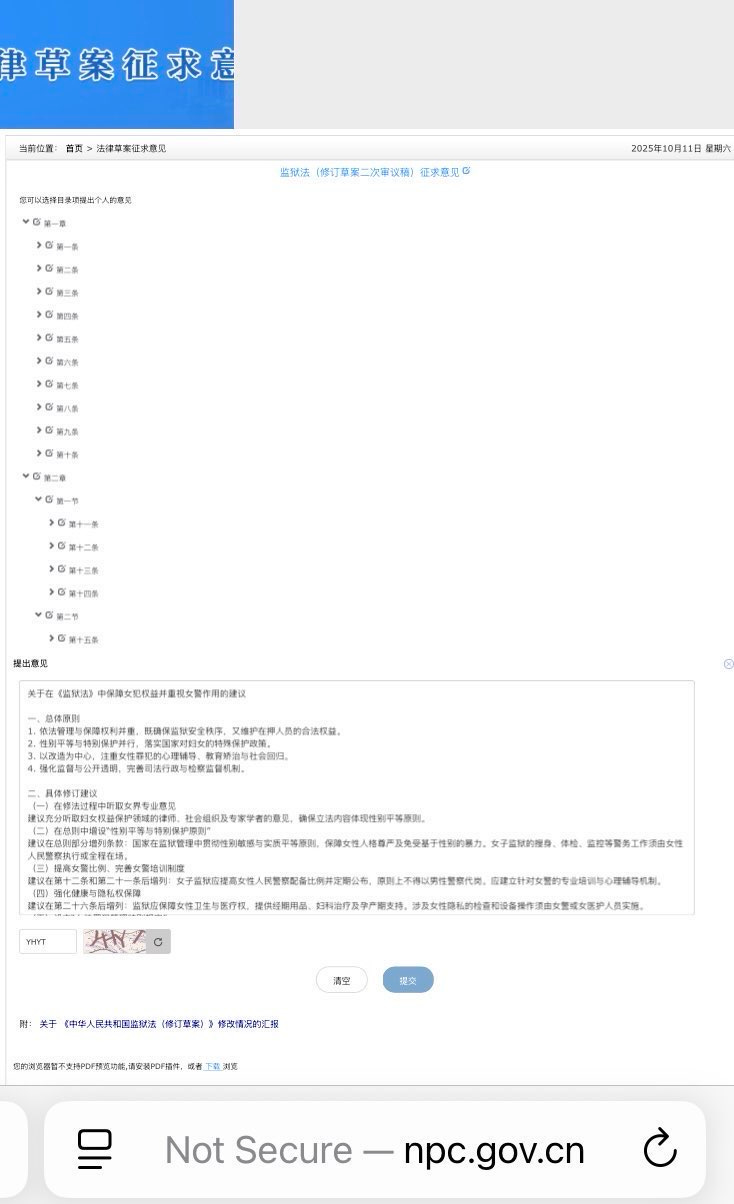
After consulting with lawyers, NGO activists, and scholars, Lu submitted four guiding principles and nine detailed recommendations through the NPC’s online platform.
Reflecting Constitutional and International Gender Equality Principles
In her proposal, Lu emphasized that the lawmaking process should include input from lawyers, NGOs, and experts working on women’s rights.
Liu Wei, a human rights lawyer from Beijing and co-founder of the “Women Human Rights Defenders Empowerment Network,” endorsed Lu’s recommendations. “China is a signatory to the Convention on the Elimination of All Forms of Discrimination against Women (CEDAW),” Liu said. “Articles 7 and 8 of CEDAW require governments to ensure women’s participation in public affairs and policymaking.”
Lu’s submission further proposes that prison management should embody gender sensitivity and substantive equality, safeguarding women’s dignity and protecting them from gender-based violence.
Zhou Fengsuo, Executive Director of Human Rights in China, also voiced support. “The Chinese Constitution guarantees equal rights for women and men,” Zhou noted. “If prison systems ignore women’s physiological and privacy-specific needs, what appears to be ‘equal treatment’ in practice becomes inequality under the guise of equality. Introducing a gender-sensitive clause is a necessary step toward realizing constitutional equality.”
Zhou also cited the United Nations Rules for the Treatment of Women Prisoners and Non-Custodial Measures for Women Offenders (the Bangkok Rules), which mandate that searches, medical examinations, and related management work involving female inmates must be conducted by female staff, with particular protection for privacy.
Ensuring Health and Privacy
Lu’s recommendations include provisions for ensuring women’s access to health and hygiene: prisons should provide menstrual products, gynecological care, and maternity support; female prisoners should not be assigned to heavy or hazardous labor; and pregnant, ill, or breastfeeding inmates should be exempted from compulsory work. Procedures involving women’s privacy must be performed by female officers or medical staff.
She also called for women’s prisons to employ gynecologists and psychological counselors, prioritize temporary medical release for pregnant prisoners, prohibit the unauthorized dissemination of private images, and establish confidential mechanisms for reporting sexual harassment and assault, supervised by prosecutors.
On the same day, the investigative media project WOMEN/我们 published a 20,000-word exposé titled Inside the Cells: The Ecology of Chinese Women’s Prisons, authored by senior journalist Ji Laizhi. Ji said that her investigation revealed serious deficiencies in the Prison Law regarding the protection of women’s physical, psychological, and privacy rights — resulting in inadequate medical services, a lack of psychological counseling, and weak mechanisms for preventing sexual abuse.
Increase Funding for Women’s Prisons and Strengthen the Role of Female Officers
According to Lu, women’s prisons bear significantly higher costs than men’s facilities due to medical, maternity, and psychological care needs, yet current funding standards make no gender distinction. Most provinces allocate identical per-capita budgets, leading to shortages of hygiene supplies, outdated facilities, and understaffed medical services — all of which directly impact women’s health and dignity.
“Moreover,” Lu noted, “female police officers remain underrepresented in many regions. Male guards sometimes fill their roles, creating risks to privacy, dignity, and safety for women prisoners. Meanwhile, female officers themselves face high psychological stress and lack professional support.”
Her proposal therefore calls for:
Higher per-capita funding for women’s prisons to meet their unique healthcare and caregiving needs;
Increased ratios of female police officers, with regular public reporting of staffing data;
A general prohibition on male officers substituting for female staff, and the establishment of specialized training and counseling programs for female officers.
Journalist Ji Laizhi commented: “Lawyer Lu’s proposal is timely and comprehensive. It considers the specific physical and psychological conditions of women detainees, especially in areas like maternal health and mental well-being. Many earlier studies have raised similar concerns, but they were never institutionalized due to staffing and budget limitations. This round of Prison Law reform offers a crucial opportunity to humanize correctional practices, strengthen privacy and gender-based safety mechanisms, and advance gender-sensitive and rights-based prison governance in China.”
Lu’s submission also calls for enhanced accountability, transparency, and the establishment of social oversight mechanisms for women’s prisons.
See the full text of Lu Miaoqing’s proposal below:
Recommendations on Strengthening the Protection of Female Prisoners’ Rights and Enhancing the Role of Female Police Officers in the Prison Law
I. General Principles
Balancing lawful management and rights protection – ensuring prison security and order while safeguarding the legitimate rights of prisoners.
Combining gender equality with special protection – implementing the state’s policies on women’s special protection.
Focusing on rehabilitation – emphasizing psychological counseling, rehabilitative education, and social reintegration for female prisoners.
Strengthening oversight and transparency – improving judicial, administrative, and procuratorial supervision mechanisms.
II. Specific Recommendations for Revision
Consult women’s rights professionals during the legislative process
Solicit opinions from lawyers, NGOs, and experts in women’s rights protection to ensure that the legislation reflects the principle of gender equality.Add a “Principle of Gender Equality and Special Protection” in the General Provisions
Insert a clause stating that the State shall implement gender-sensitive and substantive equality principles in prison administration, ensuring women’s dignity and protection from gender-based violence. Searches, medical examinations, and surveillance in women’s prisons shall be conducted or supervised by female police officers.Increase the proportion and training of female police officers
Amend Articles 12 and 21 to require that women’s prisons increase and regularly disclose the proportion of female police officers, and, as a general rule, male officers shall not substitute for female positions. Establish specialized training and psychological support programs for female officers.Strengthen health and privacy protections
After Article 26, add a provision requiring prisons to safeguard women’s health and hygiene rights, providing menstrual products, gynecological care, and maternity support. Any procedures or equipment involving women’s privacy shall be handled by female officers or medical personnel.Establish “Special Provisions for the Management of Female Prisoners”
Add a separate section or article requiring women’s prisons to employ gynecologists and psychological counselors. Pregnant or postpartum prisoners should be prioritized for temporary release for medical or maternity reasons in accordance with the law. It shall be strictly prohibited to disclose or disseminate private images of female prisoners. A reporting mechanism for sexual harassment and assault shall be established, handled by designated female officers under procuratorial supervision.Regulate prison labor and prevent exploitation
Revise Article 100 to ensure that female prisoners engage only in work appropriate to their physical and physiological conditions, excluding heavy or hazardous labor. Pregnant, ill, or breastfeeding inmates shall be exempted from compulsory labor.Strengthen fiscal and budgetary guarantees
After Article 7, add a clause stipulating that, in light of women’s special medical and caregiving needs, the State shall allocate a higher per-capita budget to women’s prisons than to men’s prisons.Enhance accountability and oversight
After Article 114, add a clause providing that prison officers who commit sexual harassment, assault, humiliation, or unlawfully disclose private images of female prisoners shall face aggravated disciplinary action or, where applicable, criminal prosecution. The procuratorate shall establish dedicated supervisory mechanisms for women’s prisons.Promote information disclosure and social oversight
Add a clause in the supplementary provisions requiring judicial administrative departments to regularly publish data on women’s prisons, including hygiene, medical services, gender composition of staff, and complaint handling. Women’s rights groups and social rehabilitation organizations may participate in prison evaluations to enhance external oversight.
《监狱法》修订草案被指忽视女犯权益,女律师建议加强性别平等
贯彻性别敏感与实质平等
保障人格尊严
免受性别暴力
2025年10月11日,来自广东的女律师陆妙卿向全国人大常委会提交了修法建议书,敦促立法机关在修订《中华人民共和国监狱法》的过程中贯彻性别敏感与实质平等、保障女犯人格尊严及免受性别暴力。陆妙卿并同时建议提高女监拨款、加强女警作用。
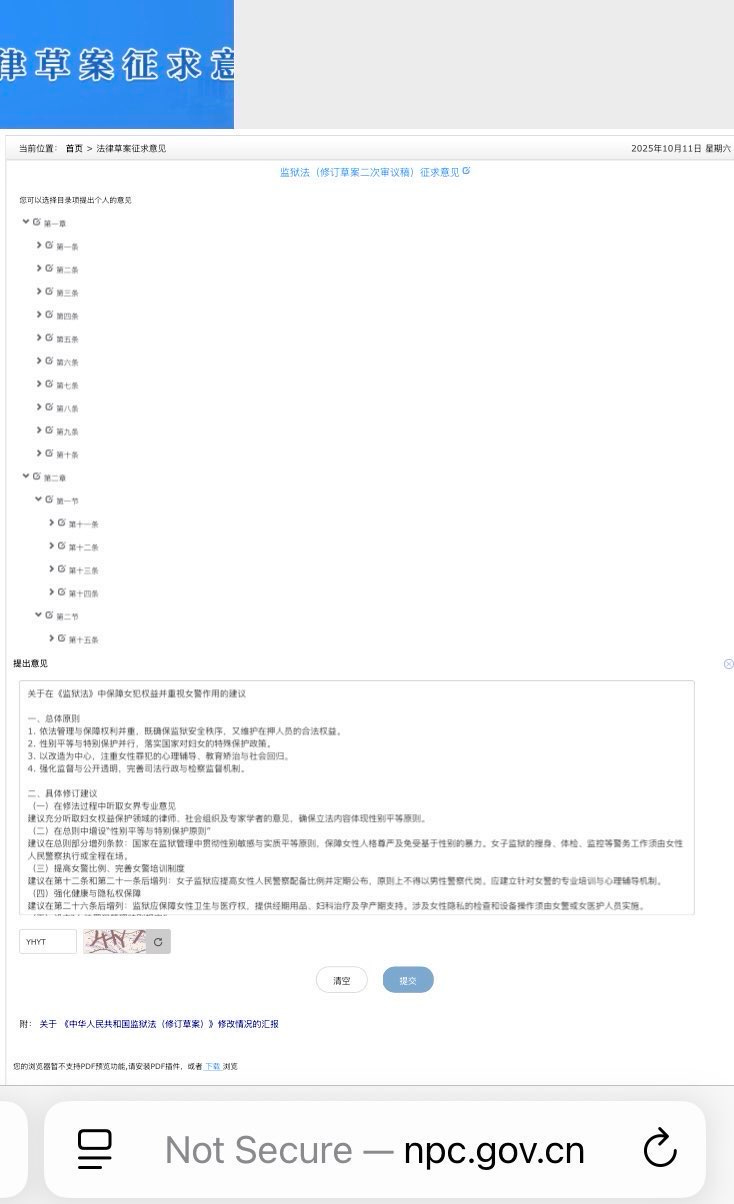
日前,全国人大常委会公布了《监狱法(修订草案二次审议稿)》,并向社会公开征求意见。现居纽约的陆妙卿发现,该修订草案忽视了女犯权益。陆妙卿曾经代理过众多妇女权利案件,例如全国强制结扎行政诉讼第一案、中国计划生育社会抚养费第一案、广州女性就业歧视第一案等。根据多年的律师执业经验,陆妙卿认为,对于女犯、尤其是女政治犯来说,在监狱中往往面临诸多额外的侵权遭遇,例如,无遮挡搜身与体检、男警执守洗澡和如厕监控摄像、缺乏厕所、热水、卫生巾、超负荷劳动、母子分离、通信被扣等。在与多位律师、NGO人士及学者讨论之后,陆妙卿在全国人大网页提交了四条原则性建议和九项具体建议。
体现宪法和国际法性别平等原则
在建议书中,陆妙卿提出,《监狱法》修法过程中应充分听取妇女权益保护领域的律师、社会组织及专家学者的意见。
来自北京的人权律师刘巍女士是“妇女人权捍卫者充权网络”的发起人之一,她对陆妙卿的建议表示赞同。刘巍指出:“中国是《消除对妇女一切形式歧视公约》(CEDAW)的缔约国。CEDAW第7条、第8条要求各国‘保障妇女参与公共事务与政策制定’”。
在建议书中,陆妙卿还提出,在监狱管理中应贯彻性别敏感与实质平等原则,保障女性人格尊严及免受基于性别的暴力。
对此,非营利机构“中国人权”执行主任周锋锁表示,《中华人民共和国宪法》保障妇女与男子平等的权利。监狱管理制度若未考虑女性生理与隐私特征,表面上“平等对待”,实质上构成“形式平等下的不平等”。增列“性别敏感与实质平等”条款,正是落实宪法平等原则的应有之义。
另外,周锋锁指出,《联合国对女性罪犯及非监禁措施的规则》(曼谷规则)也规定了上述原则和具体措施,例如第19条、第20条规定:对女性罪犯进行搜身、体检和管理工作,应由女性工作人员执行;对隐私应特别保护。
保障健康与隐私权
陆妙卿的建议还包括:监狱应保障女性卫生与医疗权,提供经期用品、妇科治疗及孕产期支持;女犯不得从事重体力或危险作业;对孕妇、病犯、哺乳期女犯应依法免除强制劳动。涉及女性隐私的检查和设备操作须由女警或女医护人员实施;应配备妇科医生和心理辅导岗位;对孕产期女犯可优先依法办理暂予监外执行;禁止擅自传播或外泄女性罪犯的隐私影像资料;建立防范性骚扰和性侵举报机制,由专门女警负责受理,检察机关实行专项监督。
10月11日,深度报道项目“WOMEN/我们”发表了长达两万余字的深度调查报道《监室之内:中国在押女子生态》。据该文作者,资深记者季来之介绍, 在调查过程中,她深感现行《监狱法》对女性罪犯的特殊生理、心理及隐私保护规定不足,导致在实践中存在医疗条件缺乏、心理辅导缺位及性骚扰防控体系不健全等问题。
提高女监拨款、强化女警作用
据陆妙卿介绍,女子监狱在医疗、孕产及心理照护方面负担显著高于男子监,需配备专门的妇科、产科及心理健康设施。然而现行拨款机制未体现性别差异,多地实行统一人均标准,导致卫生用品不足、医疗条件滞后、专业力量薄弱,直接影响在押女性的健康与尊严。
“另外,当前部分地区女子监狱中女性警力比例偏低,男性警察在部分管理环节代岗的情况仍然存在,造成女性罪犯隐私权、人格尊严及安全保障的潜在风险。同时,女警在长期高压环境下普遍存在心理负荷重、专业支持不足等问题。”,陆妙卿表示。
有鉴于此,建议书中提出,国家应根据女犯特殊医疗与照护需求,对女子监狱实行高于男子监狱的人均拨款标准;女子监狱应提高女性人民警察配备比例并定期公布,原则上不得以男性警察代岗。应建立针对女警的专业培训与心理辅导机制。
“陆律师的建议,考虑了在押女性特殊的生理与心理状况,尤其是在妇产科医疗与心理保障方面,目前是最为迫切的。事实上不少多年前的研究就提及了女性犯人的医疗照护和隐私安全要求,但是因为警力配备等原因,多年来一直没有被纳入考量。这一轮《监狱法》修改是一个机会,在母婴权益保护方面,落实人性化刑罚执行原则;在隐私与性别安全防护方面,构建举报机制与外部监督渠道,预防制度性侵害;进一步推动监狱管理的性别敏感化与人权法治化进程。”季来之表示。
建议书内容还包括,强化问责与监督、建立信息公开与社会监督制度等内容。
【附:建议书全文】
《关于在《监狱法》中保障女犯权益并重视女警作用的建议》
一、总体原则
依法管理与保障权利并重,既确保监狱安全秩序,又维护在押人员的合法权益。
性别平等与特别保护并行,落实国家对妇女的特殊保护政策。
以改造为中心,注重女性罪犯的心理辅导、教育矫治与社会回归。
强化监督与公开透明,完善司法行政与检察监督机制。
二、具体修订建议
(一)在修法过程中听取女界专业意见
建议充分听取妇女权益保护领域的律师、社会组织及专家学者的意见,确保立法内容体现性别平等原则。
(二)在总则中增设“性别平等与特别保护原则”
建议在总则部分增列条款:国家在监狱管理中贯彻性别敏感与实质平等原则,保障女性人格尊严及免受基于性别的暴力。女子监狱的搜身、体检、监控等警务工作须由女性人民警察执行或全程在场。
(三)提高女警比例、完善女警培训制度
建议在第十二条和第二十一条后增列:女子监狱应提高女性人民警察配备比例并定期公布,原则上不得以男性警察代岗。应建立针对女警的专业培训与心理辅导机制。
(四)强化健康与隐私权保障
建议在第二十六条后增列:监狱应保障女性卫生与医疗权,提供经期用品、妇科治疗及孕产期支持。涉及女性隐私的检查和设备操作须由女警或女医护人员实施。
(五)设立“女性罪犯管理特别规定”
建议新增专章或条款:女子监狱应配备妇科医生和心理辅导岗位。对孕产期女犯可优先依法办理暂予监外执行。禁止擅自传播或外泄女性罪犯的隐私影像资料。建立防范性骚扰和性侵举报机制,由专门女警负责受理,检察机关实行专项监督。
(六)规范劳动管理与防止剥削
建议修改第一百条:女犯劳动须符合其身体条件和生理特点,不得从事重体力或危险作业。对孕妇、病犯、哺乳期女犯应依法免除强制劳动。
(七)强化财政与经费保障
建议在第七条后补充:国家应根据女犯特殊医疗与照护需求,对女子监狱实行高于男子监狱的人均拨款标准。
(八)强化问责与监督
建议在第一百一十四条后增列:监狱人民警察若对在押女性罪犯实施性骚扰、性侵、侮辱或违规传播隐私影像的,从重处分;构成犯罪的,依法追究刑事责任。检察机关应建立女子监狱专项监督机制。
(九)建立信息公开与社会监督制度
建议在附则中增列:司法行政部门应定期公布女子监狱卫生、医疗、警务性别比例及申诉处理情况。可引入妇女权利组织、社会矫治机构等社会组织参与女子监狱工作评估,完善外部监督机制。