

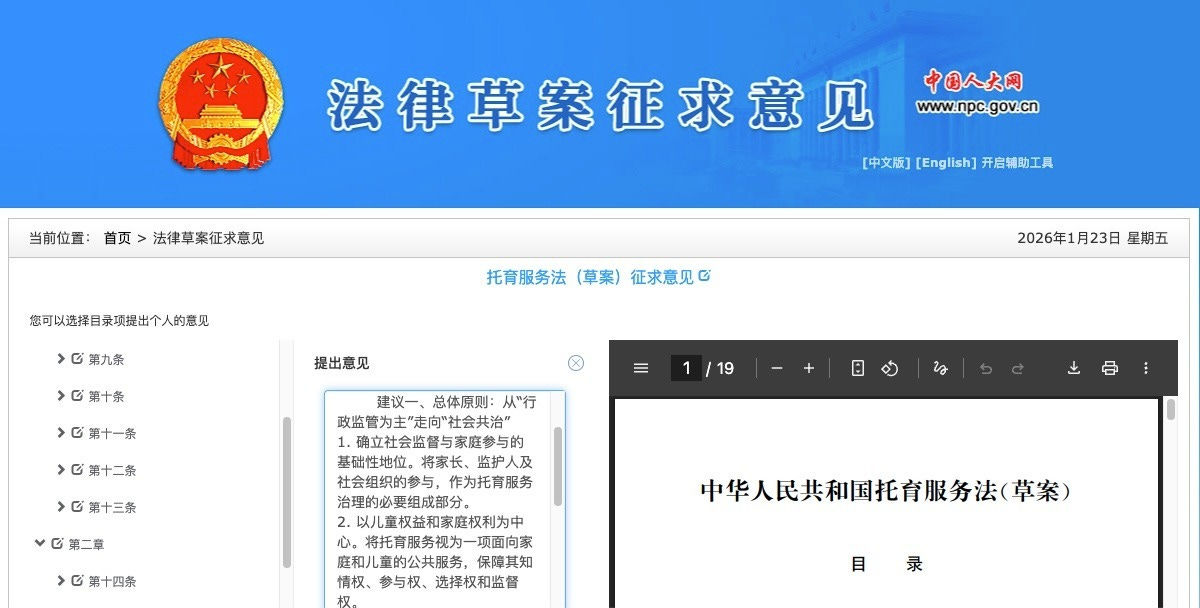
后附中文版
January 23, 2026 — Lu Miaoqing, a Chinese lawyer currently residing in the United States, recently submitted Proposed Amendments to the Draft Childcare Services Law to the Standing Committee of the National People’s Congress (NPC). In her submission, she called for stronger mechanisms of social oversight and family participation in childcare governance, emphasizing in particular the need to institutionalize parent committees as independent supervisory bodies. She argued that this would help address structural shortcomings caused by the current overreliance on administrative regulation and better prevent violations of infants’ and young children’s rights.
The 19th session of the Standing Committee of the 14th National People’s Congress recently reviewed the Draft Childcare Services Law and released it for public comment starting December 27, 2025. After studying the draft, Lu pointed out that the chapter on “Supervision and Administration” relies primarily on administrative licensing, inspections, and post-incident penalties, while providing insufficient institutional space for family participation and social oversight.
Lu practiced law in Guangzhou for more than a decade and has long worked on legal issues related to the rights of women and children. As a mother, she also served for four years as chair and vice-chair of the parent association at her child’s school. She noted that it was precisely this combination of professional experience and hands-on parenting that led her to a clear conclusion: childcare safety cannot depend excessively on government authorities “managing” institutions behind closed doors; parents and civil society must be able to see what is happening and meaningfully participate.
Administrative Regulation Is Not a Panacea: Structural Flaws Exposed
Lu observed that numerous recent cases involving abuse, corporal punishment, and neglect of children’s physical and mental well-being in childcare and early-education institutions demonstrate that administrative regulation alone cannot effectively prevent systemic risks in childcare services.
She specifically cited the widely publicized Red Yellow Blue Kindergarten incident, which sparked nationwide outrage. At the time of the incident, the institution in question held valid licenses and had undergone administrative inspections, yet serious violations of children’s rights persisted over an extended period. The case, she argued, starkly exposed the blind spots of a governance model that relies solely on administrative oversight.
“Risks in childcare services are inherently concealed, routine, and continuous,” Lu said. “Administrative inspections are often periodic and external. Those who are closest to children and best positioned to observe daily care on an ongoing basis are parents and frontline caregivers, yet they are marginalized in the current institutional framework.”
Strengthening Parent Committees: Families as Governance Actors, Not Bystanders
In response to these issues, Lu placed the parent committee system at the center of her proposed revisions to the chapter on supervision and administration.
She recommended that the law explicitly provide that childcare institutions should, in principle, establish parent committees. Such committees should not be treated as auxiliary bodies subordinate to institutions, but rather as legally recognized and independently functioning entities of social oversight.
Under her proposal, parent committees would be legally entitled to:
Access information, through reasonable means, about the institution’s daily operations;
Regularly hear briefings on care arrangements, safety management, and health safeguards;
Offer opinions and recommendations on matters affecting children’s rights and interests;
Raise inquiries concerning issues involving the safety, health, and other significant rights and interests of infants and young children; and
Publicly disclose their supervisory opinions to mass media and social media, provided that children’s dignity and personal data are protected.
At the same time, childcare institutions would be legally required to cooperate with parent committees and must not retaliate against, exclude, or indirectly restrict their lawful participation.
Lu stressed that strengthening parent committees should not be misconstrued as “weakening administrative regulation.” Rather, it is intended to remedy the institutional limitations of administrative oversight, which cannot realistically cover the details of daily care, and to embed the protection of children’s rights into the everyday operations of childcare institutions.
Mobilizing Civil Society: Building a Multi-Layered Oversight System
Beyond parent committees, Lu’s proposal also calls for support for the establishment of NGOs focused on children’s rights and family services, and for encouraging their participation in independent evaluation and oversight of childcare services.
She further suggested that judicial and administrative authorities support law firms, legal consulting services company, and individual lawyers in providing legal services to childcare institutions, parents, and parent committees.
In addition, Lu proposed introducing a childcare service voucher system, under which local governments would issue earmarked vouchers directly to eligible families to offset childcare expenses. She noted that such a system would help prevent public subsidies from being “absorbed” by institutions, improve transparency in the use of public funds, and strengthen families’ freedom of choice—allowing them to exert real pressure on service quality through “voting with their feet.”
Protecting Children’s Rights Requires “Visible, Everyday Oversight”
Zhou Fengsuo, Executive Director of the non-profit organization Human Rights in China, commented that Lu’s proposal addresses a core issue in childcare legislation.
“Institutionalizing parent committees creates oversight that is visible in everyday practice,” Zhou said. “It moves the protection of children’s rights from post-incident remedies to ex-ante prevention. This approach is also fully consistent with the spirit of the Convention on the Rights of the Child, particularly its emphasis on family participation and social oversight.”
Social Co-Governance: The Direction of Public Service Legislation
Renowned human rights lawyer Li Fangping, who has long followed issues involving discrimination and violations of vulnerable children’s rights in access to early education, noted that the significance of Lu’s proposal extends beyond the childcare sector.
“What this proposal really advances is a shift in the logic of public service governance—from a single, administration-centered model to one of shared governance involving the state, families, and society,” Li said. “In high-risk, trust-dependent fields like childcare, empowering parents and social actors is not redundant, it is a necessary condition for institutional reliability.”
Weaving a “Institutional Safety Net” for Infants and Young Children
Lu emphasized that the Childcare Services Law represents a critical legislative opportunity. Establishing family participation and social oversight mechanisms in a systematic manner at the legal level would not only help prevent rights violations, but also strengthen public trust in the childcare system as a whole.
“Childcare safety cannot be ensured solely through stricter rules, it requires better institutional design,” she said. She expressed hope that, before the law is finalized, legislators will fully incorporate input from parents, lawyers, NGOs, and researchers, in order to weave a truly effective institutional safety net for infants and young children.
Attached below: Full text of the Proposed Amendments to the Draft Childcare Services Law submitted by Lawyer Lu Miaoqing.
Proposed Amendments to the Draft Childcare Services Law
— Strengthening Family Participation and Social Oversight to Build a Multi-Stakeholder Childcare Governance System
Recently, the 19th session of the Standing Committee of the 14th National People’s Congress reviewed the Childcare Services Law (Draft) and released it for public comment starting on December 27, 2025. As both a lawyer and a mother, I have been following the drafting of this law with close attention.
Childcare services directly concern the life safety, human dignity, and physical and mental development of infants and young children. They constitute a highly sensitive public service sector characterized by concentrated and persistent risks. In recent years, demand for childcare services in China has grown rapidly; however, the corresponding governance framework still relies primarily on administrative licensing and ex post supervision. Social participation remains limited, family-based oversight channels are weak, and the overall governance structure is overly singular. In the Childcare Services Law (Draft), provisions on “supervision and administration” still inadequately reflect the role of family participation and social oversight.
Practice has repeatedly demonstrated that reliance solely on administrative regulation is insufficient to prevent systemic risks in the childcare sector. In recent years, multiple cases of abuse, corporal punishment, and neglect of children’s physical and mental well-being have occurred in childcare and early education institutions, even where such institutions possessed lawful qualifications and where administrative oversight had not been formally absent. The widely publicized “R.Y.B. Kindergarten incident,” which triggered nationwide concern, is a representative example: despite the coexistence of licensing and routine inspections, serious violations of children’s rights still occurred.
Risks in childcare services are inherently concealed, routine, and continuous in nature. Periodic administrative inspections and post-incident sanctions alone are often incapable of timely detection or prevention of harm. Parents and frontline caregivers, the actors closest to children and those with the strongest capacity for continuous observation, are afforded only extremely limited participation under the current institutional framework.
For these reasons, if the Childcare Services Law can, in its supervision and administration provisions, focus on building a multi-stakeholder governance mechanism that fully integrates administrative oversight, family participation, and social supervision, it will be better positioned to embed the protection of infants’ and young children’s rights into the daily operation of childcare institutions.
I. General Principles: From “Administration-Centered Regulation” to “Social Co-Governance”
1. Establish the Foundational Role of Social Oversight and Family Participation
The participation of parents, guardians, and social organizations should be recognized as a necessary component of childcare governance, rather than a supplementary measure.
2. Center Children’s Rights and Family Rights
Childcare services should be regarded as a public service oriented toward children and families, ensuring families’ rights to information, participation, choice, and supervision.
3. Mutual Support Between Administrative and Social Oversight
Administrative authorities should be responsible for baseline regulation and law enforcement, while social actors participate in day-to-day supervision and risk identification, forming a complementary governance structure.
II. The Parents’ Committee System as a Standing Oversight Mechanism
Building upon existing provisions in the Draft, it is recommended that the law further clarify the following:
1. Childcare institutions should, in principle, establish Parents’ Committees.
Where objective constraints, such as institutional scale or service model, make establishment infeasible, the institution shall provide justification and adopt alternative measures to safeguard parents’ participation and oversight rights.
2. Parents’ Committees are not subordinate bodies of childcare institutions.
They are legally established social oversight bodies that operate independently in accordance with the law.
3. Parents’ Committees shall legally enjoy the following rights of supervision and participation:
(1) To access information, through reasonable means, about the institution’s daily activities;
(2) To regularly receive briefings from the institution regarding caregiving arrangements, safety management, and health and hygiene matters;
(3) To make recommendations and provide opinions on caregiving methods, safety management, and health and hygiene matters affecting infants’ and young children’s rights and interests;
(4) To raise inquiries regarding matters involving the safety, health, and other significant rights and interests of infants and young children;
(5) To publicly express their supervisory opinions and recommendations through the media and social media, provided that children’s personality rights and personal information are not infringed.
4. Parents’ Committees shall perform their functions independently in accordance with the law.
Childcare institutions shall cooperate and shall not, in any form, retaliate against, exclude, restrict, or indirectly obstruct Parents’ Committees or their members from lawfully participating in childcare supervision.
III. Fostering a System of Social Oversight
It is recommended that the law clearly provide that:
Social organizations engaged in child rights protection and family services shall be supported in their lawful establishment and encouraged to conduct independent evaluation and oversight of childcare services;
Judicial and administrative authorities shall support law firms, legal consulting services company, and individual lawyers in offering legal services to childcare institutions, parents, and Parents’ Committees.
IV. Introducing a Childcare Service Voucher Scheme to Strengthen Family Participation and Oversight
It is recommended that a childcare service voucher (subsidy voucher) scheme be established, under which local governments distribute earmarked vouchers to eligible families with infants and young children for the purpose of offsetting childcare costs.
Such a voucher scheme offers the following institutional advantages:
Preventing fiscal subsidies from being “absorbed” by institutions, ensuring that public funds genuinely reduce families’ financial burdens;
Enhancing transparency in the use of public funds, facilitating oversight by families and society;
Promoting healthy competition among childcare institutions and incentivizing improvements in service quality;
Strengthening families’ voice and freedom of choice in childcare services, thereby creating a supervision mechanism based on “voting with one’s feet.”
《托育服务法(草案)》被指社会监督不足 女律师建议强化家长委员会
2026年1月23日,现居华盛顿的中国女律师陆妙卿向全国人大常委会提交《关于〈托育服务法(草案)〉的修改建议》,呼吁在立法中强化社会监督与家庭参与机制,尤其是通过确立家长委员会的独立地位,弥补托育服务中过度依赖行政监管的制度缺陷,更有效地预防侵害婴幼儿权益的行为。
日前,十四届全国人大常委会第十九次会议审议了《托育服务法(草案)》,并自12月27日起向社会公开征求意见。陆妙卿在研究草案后指出,草案在“监督管理”章节中,主要依靠行政审批、行政检查和事后处罚,对家庭和社会的制度性参与规定明仍然不足。
陆妙卿曾在广州执业14年,长期从事妇女和儿童权益相关法律事务。作为母亲,她本人曾担任儿子就读学校的家长会主席、副主席四年。她表示,正是长期的执业经验与育儿实践,让她深刻认识到,托育安全不能过度依靠行政部门“管”,还必须让家长和社会“看得见、参与得上”。
行政监管并非万能 现状暴露结构性问题
在建议信中,陆妙卿指出,近年来托育和幼教机构中发生的多起虐待、体罚、忽视儿童身心健康的案件表明,仅依赖行政监管,并不能有效防范托育服务中的系统性风险。
她特别提及曾引发全国舆论关注的“红黄蓝幼儿园事件”。该事件发生时,涉事机构具备合法资质,也接受过行政检查,但严重侵害儿童权益的行为仍长期存在,暴露出单一行政监管模式在托育领域的明显盲区。
“托育服务的风险具有隐蔽性、日常性和持续性特征。”陆妙卿指出,“行政检查往往是周期性的、外部的,而真正最接近儿童、最有条件持续观察照护过程的,是家长和一线照护人员,但他们在制度中却被边缘化。”
确立家长委员会 家庭成为治理主体而非旁观者
针对上述问题,陆妙卿在建议中将家长委员会制度作为“监督管理”章节的核心内容之一。
她建议明确规定:托育机构原则上应当建立家长委员会;家长委员会不是托育机构的附属组织,而是依法设立、独立履职的社会监督主体。家长委员会应依法享有了解托育机构日常活动、听取情况说明、提出意见建议、就涉及婴幼儿重大权益事项提出质询的权利,并在不侵犯婴幼儿人格权和个人信息的前提下,依法向媒体和自媒体公开监督意见。
同时,托育机构应当依法配合家长委员会履职,不得以任何形式打击、排斥或变相限制其参与。
陆妙卿强调,强化家长委员会不能理解为“削弱行政监管”,而是弥补行政监管无法覆盖日常照护细节的制度性不足,有助于将婴幼儿权益保护真正嵌入托育机构的日常运行之中。
引入社会力量 构建多层次监督体系
除家长委员会外,建议信还提出,应当支持设立儿童权益保护组织,并支持其参与托育服务的独立评估与监督;司法行政部门应支持律师事务所、法律咨询机构和律师个人,为托育机构、家长及家长委员会提供法律服务,逐步形成多层次、可持续的社会监督网络。
此外,陆妙卿建议引入托育服务消费券制度,将财政补贴以“专券专用”的形式直接发放给家庭,用于抵扣托育费用。她指出,消费券制度不仅有助于防止财政补贴被机构“吸收”,提高资金使用透明度,也能增强家庭选择权,通过“用脚投票”的方式,形成对托育机构服务质量的现实约束。
儿童权利保护:需要“日常可见的监督”
非营利机构“中国人权”执行主任周锋锁认为,陆妙卿的建议抓住了托育立法中的关键问题,“将家长委员会制度化,实现了日常可见的监督,是将儿童权利保护从‘事后救济’前移到‘事前预防’的重要一步,也符合《儿童权利公约》中关于家庭参与和社会监督的基本精神。”,周锋锁表示。
社会共治:公共服务立法的发展方向
知名人权律师李方平认为,这份建议的意义不仅限于托育领域。
“这实际上是在推动公共服务治理逻辑的转变——从单一行政管理,走向政府、家庭和社会多方共治。” 李方平表示,“在托育这样高风险、强依赖信任的领域,突出家长和社会力量,不是‘多此一举’,而是提高制度可靠性的必要条件。”
为婴幼儿织密“制度性的安全网”
陆妙卿表示,《托育服务法》是一次重要的立法契机。如果能够在法律层面系统确立家庭参与和社会监督机制,不仅有助于预防侵权事件发生,也能增强公众对托育服务体系的信任。
“托育安全不能只靠更严的规定,而要靠更合理的制度设计。” 她表示,希望立法机关在最终通过法律前,能够充分吸收来自家长、律师、社会组织和研究者的意见,为婴幼儿织密一张真正有效的制度性安全网。
【附:陆妙卿律师提交的《关于〈托育服务法(草案)〉的修改建议》全文】
关于《托育服务法(草案)》的修改建议
——强化家庭参与和社会监督,构建多元共治的托育服务治理体系
近日,十四届全国人大常委会第十九次会议对《托育服务法(草案)》进行了审议,2025年12月27日起公开征求意见。作为律师及母亲,本人对该法的制定非常关注。托育服务直接关系婴幼儿生命安全、人格尊严与身心发展,是高度敏感、风险集中的公共服务领域。近年来,中国托育服务需求快速增长,但相应的治理机制仍以行政审批和事后监管为主,社会参与不足,家庭监督渠道有限,治理结构单一。而《托育服务法(草案)》中对“监督管理”的规定,家庭参与和社会监督的作用仍然不足。
实践反复表明,仅依赖行政部门监管,并不能有效防范托育领域的系统性风险。近年来,托育和幼教机构中发生的多起虐待、体罚、忽视儿童身心健康的事件,均是在“机构具备合法资质、行政监管并未缺位”的情况下发生的。其中,曾引发全国关注的“红黄蓝幼儿园事件”,正是行政许可、定期检查并存,却仍发生严重侵害儿童权益行为的典型案例。
托育服务的风险具有隐蔽性、日常性和持续性特征,单靠周期性行政检查和事后处罚,难以及时发现和制止侵权行为。最接近儿童、最具持续观察能力的主体——家长和一线照护者,在现行制度中却仅有极其有限的参与空间。
因此,《托育服务法》对“监督管理”的立法,如果能着力构建多元共治机制、将行政监管、家庭参与、社会监督充分结合,将能更好地把婴幼儿权益保护嵌入托育机构日常运行之中。
建议一、总体原则:从“行政监管为主”走向“社会共治”
1. 确立社会监督与家庭参与的基础性地位
将家长、监护人及社会组织的参与,作为托育服务治理的必要组成部分,而非补充手段。
2. 以儿童权益和家庭权利为中心
将托育服务视为一项面向家庭和儿童的公共服务,保障其知情权、参与权、选择权和监督权。
3. 行政监管与社会监督相互支撑
行政部门负责底线监管和执法,社会主体参与日常监督和风险预警,形成治理合力。
建议二、家长委员会制度,应作为常设监督机制
在草案已有规定基础上,建议进一步明确:
1. 托育机构原则上应当建立家长委员会。
确因机构规模、托育模式等客观条件限制无法建立的,应当说明理由,并采取其他形式保障家长参与和监督权利。
2. 家长委员会不是托育机构的附属组织,而是依法设立、独立履职的社会监督主体。
3. 家长委员会依法享有以下监督与参与权利:
(1)通过合理方式,了解托育机构的日常活动;
(2)定期听取托育机构就照护安排、安全管理、卫生保障等事项的情况说明;
(3)就照护方式、安全管理、卫生条件等涉及婴幼儿权益的事项提出意见和建议;
(4)对涉及婴幼儿安全、健康和其他重要权益的事项提出质询;
(5)在不侵犯婴幼儿人格权及保护个人信息的前提下,向媒体和自媒体公开其监督意见和建议。
4. 家长委员会依法独立履职,托育机构应当予以配合,不得以任何形式打击、排斥、限制或变相妨碍家长委员会及其成员依法参与托育服务监督。
建议三、营造社会监督体系
建议明确:
1. 对于涉及儿童权益保护、家庭服务领域的社会组织,支持其依法设立,支持其对托育服务开展独立评估与监督;
2. 司法行政部门应支持律师事务所、法律咨询公司和律师个人为托育机构、家长、家长委员会提供法律服务。
建议四、引入托育服务消费券制度,强化家庭参与和监督基础
建议建立托育服务消费券(补贴券)制度,由地方政府以“专券专用”的形式向符合条件的婴幼儿家庭发放,用于抵扣托育费用。
消费券制度具有以下制度优势:
1. 防止财政补贴被机构“吸收”,确保公共资金真正用于减轻家庭负担;
2. 提高财政资金使用透明度,便于家庭和社会监督资金流向;
3. 促进托育机构之间的良性竞争,倒逼服务质量提升;
4. 增强家庭在托育服务中的话语权和选择权,形成“用脚投票”的监督机制。